Most advice about how to get more followers on linkedin is too shallow to be useful.
“Post more” is incomplete. It ignores the part that drives outcomes: what happens when someone sees you for the first time. Followers don’t appear because you published another generic carousel. They show up when your profile makes a strong promise, your content proves that promise, and your engagement puts you in front of the right people often enough to matter.
That’s the playbook I trust. Not random posting. Not engagement pods. Not broad commenting on anything with traction. A working LinkedIn system has three moving parts: a profile that converts visits into follows, content built around repeatable themes, and a daily engagement engine that creates borrowed visibility from people who already have your audience’s attention.
For B2B founders and sales reps, that last piece is where most growth gets left on the table. A strong comment on the right post can outperform your own post because it gets discovered inside a conversation your prospects are already having. When you scale that safely, consistently, and with context, LinkedIn starts compounding.
Foundation First Your Profile as a Follower Magnet
A generic profile repels followers because it reads like a resume written for recruiters, not a landing page built for your market. When someone clicks from your post or your comment, they’re asking a simple question: what will I keep getting if I follow this person?
If your headline only says your job title, your About section rambles through your career history, and your Featured section is empty, you’re wasting attention you already earned.

Write a headline people can follow
Your headline should do more than identify you. It should position you.
A useful formula is:
Who you help + problem you solve + angle or credibility
That doesn’t mean stuffing every keyword you can think of into one line. It means being specific enough that the right visitor immediately feels, “This is for me.”
Here’s the difference:
- Weak version: Founder at ABC Tech
- Better version: Helping B2B SaaS teams turn LinkedIn engagement into pipeline
- Better for a sales rep: Sharing outbound, follow up, and social selling lessons for B2B SDRs
The best headlines create expectation. If I follow you, I know what I’ll learn.
Practical rule: If your headline could belong to a thousand other people in your industry, it’s too vague.
Use your About section like a sales page
Most About sections fail because they start with biography instead of relevance. Your visitor doesn’t need your life story first. They need a reason to stay.
A stronger structure looks like this:
- Open with the audience problem
- State what you help them do
- Explain how you think
- Back it up with experience or point of view
- End with what people can expect from following you
For example, a founder might open with the pain of getting impressions but no pipeline. A recruiter might speak to standing out in a crowded hiring market. A consultant might focus on turning expertise into demand.
Keep it readable. Short paragraphs. Clear language. No corporate filler.
Treat Featured like proof, not decoration
Your Featured section should answer, “What should I look at next?”
That could include:
- A flagship post that captures your point of view
- A lead magnet or guide that proves depth
- A case based post showing how you solve problems
- A podcast or interview where your expertise comes through clearly
If you want inspiration, these LinkedIn profile examples are useful for spotting patterns in profiles that convert attention into action.
I’ve found that most B2B profiles improve fastest when they stop trying to look impressive and start trying to look useful.
Small profile choices that change conversion
A few details matter more than people think:
- Profile photo should be clean, current, and easy to recognize in the feed.
- Banner should reinforce your positioning, not just your logo.
- Creator Mode is worth enabling if audience growth matters to you because it supports a more creator friendly setup, including a more visible follow behavior and access to content oriented features.
- Experience section should support your authority, but it shouldn’t overpower your promise.
If you want a broader strategic lens on positioning your company and personal presence together, Big Moves Marketing has a solid Marketing B2B LinkedIn guide that complements this profile first approach.
The Content Strategy That Fuels Follower Growth
Random posting feels productive right up until it burns you out.
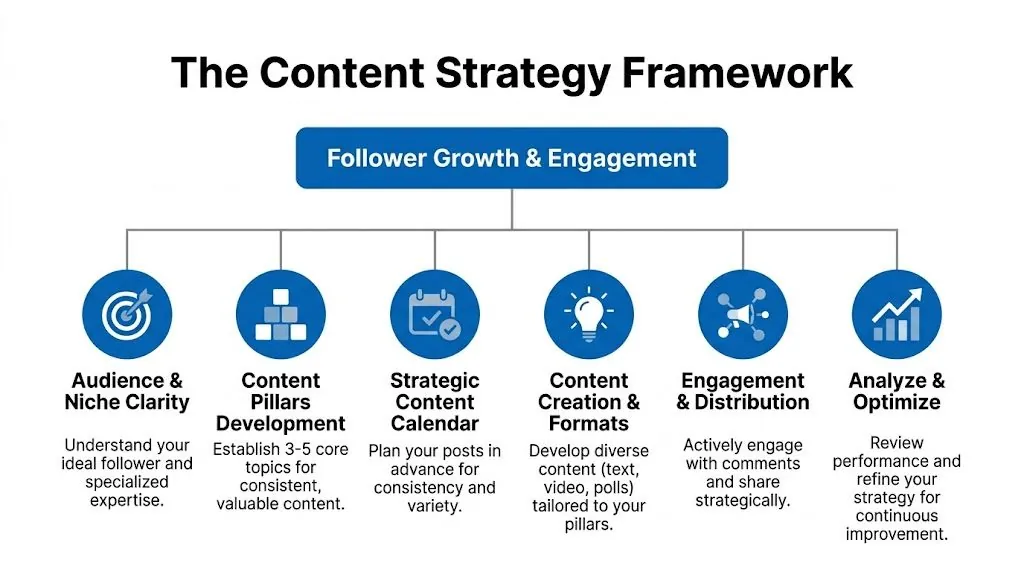
A better system starts with content pillars. These are the few themes you want to be known for repeatedly. When your audience sees enough of the right posts from you, pattern recognition kicks in. They know what lane you own, and that clarity is what makes following easy.
According to LinkedIn data reported by Hootsuite, businesses that post weekly on LinkedIn experience 5.6 times more follower growth compared to those that do not post as often (LinkedIn weekly posting data via Hootsuite). Consistency matters, but consistency without direction just creates more noise.
Choose pillars you can sustain
Individuals often pick pillars that sound smart, not pillars they can publish on every week.
Good pillars sit at the overlap of three things:
| Element | What to ask |
|---|---|
| Expertise | What do you know well enough to explain simply? |
| Audience pain | What problems does your buyer keep running into? |
| Business relevance | Which topics attract the kind of follower you actually want? |
For a B2B founder, that might be:
- Demand generation
- Founder led sales
- Hiring and team lessons
- Category insight
For a sales rep, it might be:
- Prospecting
- Follow up
- Objection handling
- Social selling
Notice what’s missing: broad catch all themes like “business,” “mindset,” or “leadership.” Those themes are too wide unless you already have a very clear audience lens.
Build a weekly mix, not a daily scramble
Once your pillars are set, the feed gets easier to manage.
I like a weekly content mix where each post has a job:
- One post teaches a repeatable lesson.
- One post shares an opinion that sharpens your positioning.
- One post tells a story from the field.
- One post invites interaction, usually through a question, poll, or observation.
- Optional extras can support launches, hiring, or timely industry reactions.
That structure removes one of the biggest causes of inconsistency: deciding from scratch every morning what to say.
You don’t need endless ideas. You need a repeatable angle on the same few problems your buyers care about.
Create content in batches
Batching keeps quality up because you’re thinking strategically, not reacting emotionally to a blank page.
A practical workflow:
- List audience questions from sales calls, DMs, and objections.
- Sort them into pillars.
- Turn one question into multiple formats. A post, a poll, a short video, a comment prompt.
- Draft several hooks at once so you can pick the strongest.
- Schedule lightly and leave room for timely posts.
Founders often overcomplicate things. They think every post needs a brand new idea. It doesn’t. It needs a fresh expression of a problem your audience already wants solved.
If you need help structuring educational content around audience pain points, Build Emotion’s content marketing guide has useful framing for turning expertise into a sustainable publishing rhythm.
Match pillars to follower intent
Not every post should chase reach. Some posts should filter.
That means asking, “Who do I want this to attract?” before you write. A post that gets fewer likes but attracts founders, revenue leaders, or ideal buyers is often doing more work than a broad motivational post that gets attention from everyone and relevance from no one.
Here’s a simple decision filter:
- If the post teaches process, it attracts practitioners.
- If the post shares conviction, it attracts people who agree with your worldview.
- If the post shows results or lessons learned, it attracts people closer to buying.
- If the post is too generic, it attracts curiosity, not fit.
The point isn’t to become repetitive. The point is to become recognizable. On LinkedIn, recognizable beats random every time.
Mastering LinkedIn Content Formats That Connect
A solid strategy still falls apart if the format doesn’t fit the message.
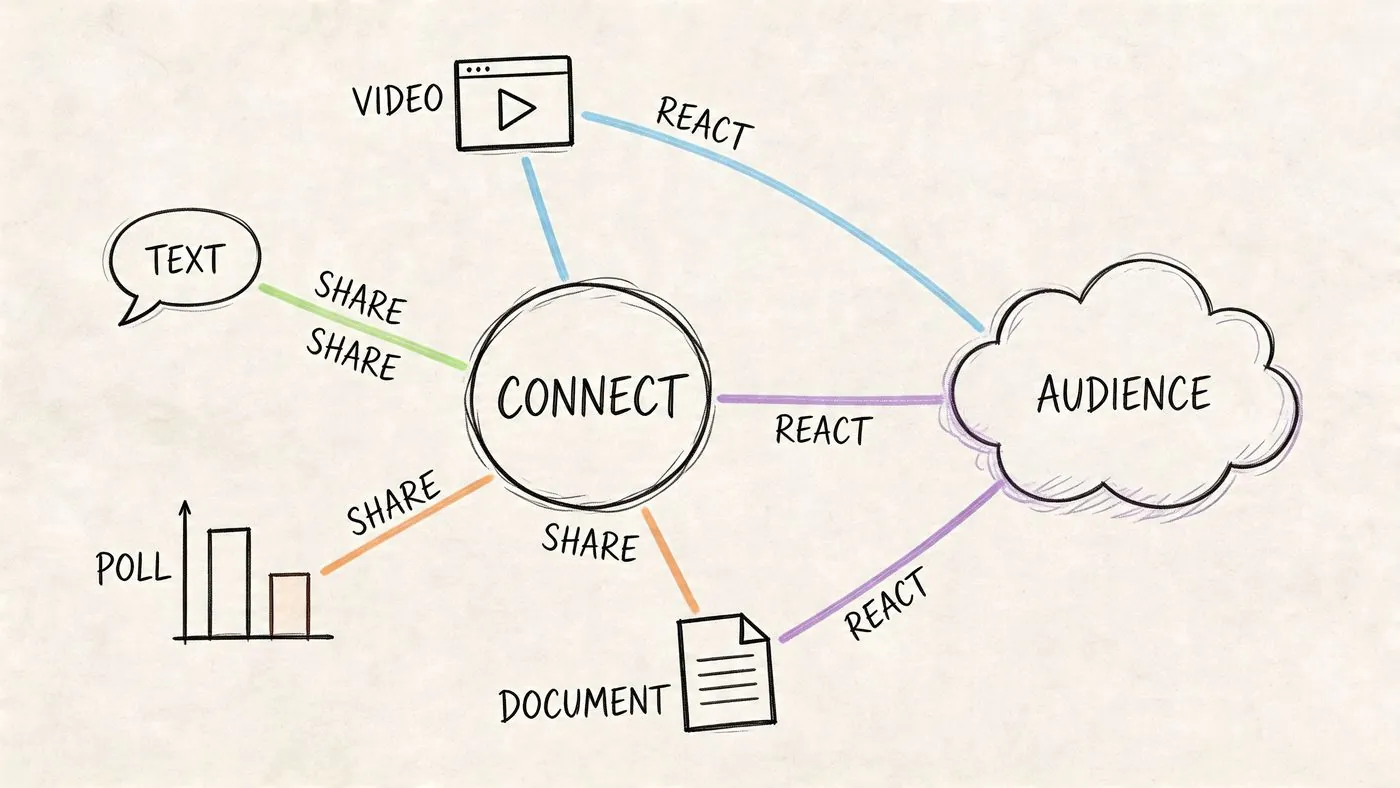
I’ve found that a lot of creators pick formats based on what looks popular in the feed. That’s backwards. Start with the kind of reaction you want, then choose the format that makes that reaction easiest.
Text posts for sharp opinions and practical lessons
Text only posts still work well when the writing is tight and the idea is clear.
A useful structure is AIDA:
- Attention with a strong first line
- Interest by framing a real problem
- Desire through a practical insight or contrarian point
- Action with a clean prompt or takeaway
A founder post might open with a mistake in pipeline generation. A sales post might start with a failed follow up sequence and what changed. The key is specificity.
A few rules help:
- Keep the hook easy to understand on mobile.
- Use short lines, but don’t chop every sentence into fragments.
- Make one point per post.
- End with a real invitation to respond, not “Thoughts?”
Carousels when the lesson needs structure
Use carousels when your idea benefits from sequence. Frameworks, teardown posts, process walkthroughs, and before and after thinking all work well here.
A good carousel gives the reader a reason to keep swiping:
- Slide one promises a clear outcome.
- Middle slides deliver the logic step by step.
- Final slide summarizes or redirects to conversation.
Carousels are often overdesigned and underwritten. Clean beats flashy. If the idea is weak, design won’t rescue it.
Polls for feedback and segmentation
Polls are underrated when used properly. Asking broad questions often yields shallow answers. Better polls surface buyer intent.
For example, instead of asking “Do you use LinkedIn for business?” ask a question tied to a real decision:
- What’s slowing your LinkedIn growth most right now?
- Which part of your outbound process breaks most often?
- What kind of content do you want more of from sales leaders?
The value is not the poll itself. The value is in the comments it generates and the language your audience uses in response.
Video for trust and familiarity
Video compresses trust faster than text because people hear your tone and see how you think. It doesn’t need to be polished to work. In many B2B contexts, clarity beats production.
A simple format works:
- Start with a problem
- Add one lesson
- Close with one practical action
This short clip gives a good sense of how to think about follower building content in a more intentional way:
Live formats create stronger interaction
If your goal is engagement, live content deserves more attention. According to Social Shepherd, live stream videos on LinkedIn receive, on average, 7 times more reactions and 24 times more comments than regular prerecorded videos (LinkedIn live video engagement stats).
That doesn’t mean every creator should go live constantly. It means live is a strong option when you want conversation rather than passive consumption.
Use live sessions for:
- Q&A sessions around a niche problem
- Breakdowns of current market changes
- Mini workshops for founders or reps
- Interviews with adjacent experts
The best format isn’t the one LinkedIn seems to prefer. It’s the one that makes your expertise easiest to absorb and easiest to remember.
A practical format map looks like this:
| Format | Best use | Common mistake |
|---|---|---|
| Text post | Opinions, lessons, stories | Weak first line |
| Carousel | Frameworks, step by step teaching | Too much design, too little substance |
| Poll | Feedback, segmentation, comment prompts | Asking vague questions |
| Short video | Trust, nuance, personality | Overproducing and posting too rarely |
| Live | Dialogue, depth, authority | Going live without a clear topic |
If you’re serious about growth, vary the formats but keep the message consistent. Different packaging. Same core expertise.
Your Daily Routine for High Impact Engagement
Most follower growth strategies often get lazy. They assume your feed is the only place authority gets built.
It isn’t.
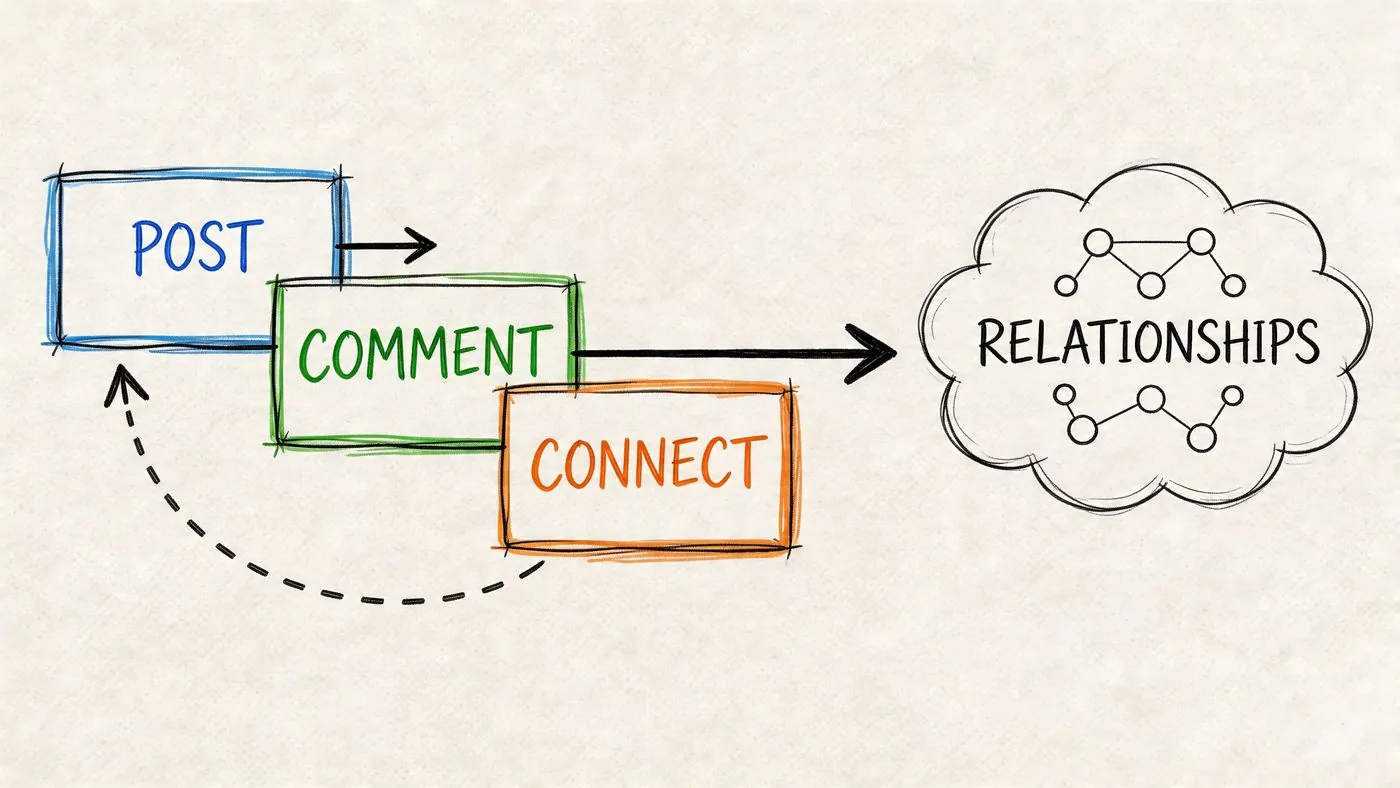
Some of the strongest LinkedIn growth comes from showing up in the comment sections your ideal followers already read. That’s the essence of borrowed visibility. You’re stepping into an existing room, adding something useful, and giving people a reason to click through to your profile.
What random commenting gets wrong
A lot of people hear “engage more” and start leaving low value comments everywhere.
“Great post.”
“Totally agree.”
“Thanks for sharing.”
That activity feels productive because it creates motion. In practice, it rarely creates interest. The wrong comment on the wrong post does nothing for your positioning.
The better approach is selective. A contrarian perspective, backed by platform dynamics, shows that random commenting fails to grow followers, while targeted commenting on niche specific posts where ideal prospects engage can boost profile visits by 5 to 10x via algorithmic amplification. Data from 2025 indicates profiles can gain 200 to 500 followers monthly from just 20 targeted comments per day (targeted LinkedIn commenting data).
The routine I’d use if starting from scratch
If I were building from zero in a B2B niche, my daily routine would look like this.
Morning scan
- Review posts from a small list of target creators, customers, peers, and industry operators.
- Check for conversations tied to your offer, category, or audience pain points.
- Ignore posts with broad consumer style engagement if your buyers aren’t there.
Commenting block
- Leave a handful of comments where you can add a missing angle, practical example, respectful disagreement, or short framework.
- Prioritize posts where your ideal buyer is likely reading the thread.
- Write comments that stand alone. Someone should get value from your comment without clicking your profile.
Follow up block
- Reply to anyone who responds to your comments.
- Visit profiles of people interacting repeatedly.
- Start conversations where there’s a natural business fit.
This isn’t about volume for its own sake. It’s about showing up where relevance is already concentrated.
A good comment doesn’t summarize the post. It extends it.
What a strong comment looks like
Here’s the difference in practice.
Weak comment:
Great advice. Consistency is key.
Strong comment:
Consistency matters, but I’ve found the bigger issue is message drift. A founder can post every week and still stall if each post speaks to a different buyer problem. The audience grows faster when the same core problem shows up from multiple angles.
The second one works because it adds a usable idea. It also signals expertise without trying too hard.
A weekly layer on top of the daily routine
The daily routine builds visibility. The weekly routine sharpens it.
Once a week, review:
- Which creators attracted the right audience
- Which comments sparked profile visits or conversations
- Which topics generated replies from potential buyers
- Which posts were too broad to be worth your time
Then adjust your target list.
I’ve seen founders waste hours engaging with “big” creators whose audience never converts into meaningful relationships. Reach is not the point. Audience fit is.
Where to look for the right conversations
You don’t need to monitor the entire platform. You need a focused watchlist.
A practical mix usually includes:
- Creators in your niche with active comments from your target buyer
- Peers one level above you who attract the market you want
- Customers and prospects posting about operational pain points
- Adjacent experts whose audience overlaps yours
For sales teams, this can be especially effective around posts discussing hiring, tooling, outbound, budget pressure, or team performance. Those topics often surface intent before someone ever fills out a form or books a demo.
The key lesson is simple. Your own posts build your home base. Your comments build your discovery engine.
Scaling Growth with Intelligent Automation
Manual engagement works. It also breaks the moment your calendar gets crowded.
That’s the tension. Founders, reps, and lean marketing teams know targeted commenting can drive visibility, but most can’t sustain the routine every day without help. Automation then enters the conversation, and it usually gets discussed badly.
There’s a huge difference between spam bots and intelligent assistants.
Spam bots blast generic comments, ignore context, and create obvious risk. Intelligent tools monitor defined targets, work within platform limits, and help you scale a strategy that already works manually. If you don’t separate those two categories, every discussion about automation turns into fear instead of judgment.
What safe automation should actually do
A useful engagement tool should support human strategy, not replace it.
Look for systems that can:
- Monitor keywords or creators relevant to your niche
- Generate contextual drafts tied to the actual post
- Allow approval workflows before anything goes live
- Respect account limits rather than forcing volume
- Match tone and language to your brand and audience
That setup is very different from old school automation that tries to fake activity at scale.
For B2B founders and sales reps, the gap in scaling targeted commenting creates missed lead generation opportunities. AI platforms can automate contextual comments within 30 minutes on monitored keywords or creators, respect limits, and enable timezone targeting for global audiences. This approach is also described as being trusted by over 10,000 users for consistent, safe engagement on PowerIn’s platform overview.
Where automation fits in the stack
I wouldn’t automate your thinking. I would automate your monitoring, your first draft workflow, and the repetitive part of discovering opportunities.
That means:
- You still define the market.
- You still choose the creators and keywords.
- You still refine tone and positioning.
- The tool reduces the manual hunt and helps you respond consistently.
If you’re evaluating broader outreach systems alongside engagement workflows, this piece on automated LinkedIn outreach is a helpful contrast because it highlights where conversation building and direct outreach serve different jobs.
Automation should scale relevance. The moment it scales laziness, it starts hurting your brand.
When automation goes wrong
It usually fails for one of three reasons:
| Problem | What it looks like | Better approach |
|---|---|---|
| No targeting discipline | Comments appear on loosely related posts | Narrow the creator list and keyword set |
| No tone control | Replies sound robotic or oddly enthusiastic | Train for your actual writing style |
| No review process | Inappropriate comments slip through | Use manual approval where needed |
Used well, automation is not a shortcut to fake credibility. It’s a way to execute a proven engagement habit without depending on perfect discipline every day.
That matters because LinkedIn rewards people who stay present in relevant conversations. Most professionals don’t fail because they lack insight. They fail because they can’t maintain the cadence required for insight to be seen.
How to Measure and Iterate Your LinkedIn Strategy
If you want follower growth that lasts, stop judging LinkedIn by vibes.
You need to know which actions move the right metrics. LinkedIn analytics aren’t just there to flatter you with impressions. They tell you whether your profile, content, and engagement routine are pulling in the audience you want.
A useful starting point is understanding the difference between visibility and traction. Impressions tell you how often your content was seen. Follows, profile visits, comments, and audience quality tell you whether visibility translated into interest. If you need a clear baseline on the first metric, this explanation of what an impression means on LinkedIn is worth reviewing.
The metrics that deserve your attention
Watch these first:
- Follower trend. Are you gaining the right audience steadily, or only in spikes?
- Engagement rate. Which posts generate active response instead of passive views?
- Profile visits. Are your posts and comments making people curious enough to click?
- Audience demographics. Are the roles, functions, and seniority levels aligned with your market?
- Page and post patterns. Which themes keep working, and which ones only looked promising once?
If a post gets attention but drives no profile curiosity, it may be entertaining without building authority. If comments drive profile visits from relevant buyers, that activity deserves more time.
Use format data to make sharper bets
Not all formats deserve equal effort all the time. According to Buffer’s reporting on LinkedIn’s Q1 2026 report, video and polls can drive a 300% engagement uplift, but 70% of B2B creators underuse them. The same source notes that failing to use niche hashtags can cause reach to drop by as much as 60% in competitive markets (LinkedIn video, polls, and hashtag insights).
That doesn’t mean switching your entire strategy overnight. It means testing whether your audience responds better when your existing expertise is packaged in a more interactive format.
A practical test cycle looks like this:
- Keep one content pillar constant.
- Publish that pillar in different formats over time.
- Compare engagement quality, not just raw reach.
- Check whether the followers gained match your target audience.
- Keep the format if it improves both response and fit.
Look for signals, not vanity
The strongest LinkedIn operators I know ask a short set of questions every week:
- Which post brought the most relevant people to my profile?
- Which comment thread led to actual conversations?
- Which topic attracted the wrong audience?
- Which format felt expensive to produce but weak in return?
- Which hook made the right people stop scrolling?
That review habit matters more than any single tactic. Growth on LinkedIn usually comes from small adjustments made consistently, not dramatic reinventions.
If your follower count is rising but your inbound conversations aren’t improving, something is off. Usually it’s one of three things: weak profile conversion, broad content, or engagement happening in the wrong rooms. Fix those, and the platform starts working like a system instead of a guessing game.
If you want to scale the targeted commenting side of this playbook without spending your day hunting for posts manually, PowerIn is built for that workflow. It monitors keywords and creators, drafts contextual comments, and helps teams stay active in relevant LinkedIn conversations with more consistency.