You’re active on LinkedIn. You post when you can. You send connection requests in bursts. You comment on a few posts, disappear for a week, then come back when pipeline feels thin.
That pattern looks productive, but it rarely produces predictable leads.
If you want to learn how to generate leads on LinkedIn, stop treating the platform like a place to “show up” and start treating it like a system. The people who win on LinkedIn aren’t always louder. They’re usually tighter. Better targeting, better positioning, better timing, better follow up.
LinkedIn is worth that effort. It generates approximately 80% of all B2B social media leads, has a 2.74% visitor to lead conversion rate, and 89% of B2B marketers actively use it for lead generation, according to CClarity’s LinkedIn lead generation statistics. The opportunity is real. The problem is that many teams approach it with random activity instead of an operating model.
That’s the gap this playbook fixes.
Why Your LinkedIn Efforts Aren't Generating Leads
Weak LinkedIn programs often have the same symptoms.
You publish content with no clear audience. You send requests to people who technically fit your market but have no reason to care. You open DMs with a pitch before earning attention. Then you conclude LinkedIn “takes too long” or “doesn’t work for our niche.”
It usually isn’t a platform problem. It’s a systems problem.
Activity isn't the same as demand generation
A lot of founders and sales teams are doing random acts of marketing on LinkedIn.
That looks like:
- Posting broad content: You talk to everyone, so no one feels specifically addressed.
- Prospecting by loose job title: You target “Head of Marketing” without filtering for company type, buying context, or actual need.
- Sending cold asks too early: The first message asks for time before trust exists.
- Ignoring the profile: Prospects click your name, find a vague headline and a resume style summary, then leave.
- Treating comments as vanity: You react to posts, but you don't use engagement to create familiarity with buyers.
None of that compounds.
LinkedIn is too valuable to run casually
If you sell B2B, LinkedIn isn’t optional. It’s the core social platform for reaching buyers in a professional context.
CClarity reports that LinkedIn drives approximately 80% of all B2B social media leads, converts visitors to leads at 2.74%, and that 89% of B2B marketers use it for lead generation through the platform’s professional targeting and buyer relevance in B2B workflows, as shown in these LinkedIn lead generation statistics.
That matters for one reason. If your LinkedIn motion is weak, you’re likely underperforming in a channel your market already uses.
Practical rule: Don't judge LinkedIn by your posting frequency. Judge it by whether a defined buyer repeatedly sees you, understands what you do, and has an easy path to reply.
If you need a broader demand gen view beyond LinkedIn alone, Truelist’s roundup of 10 Proven B2B Lead Generation Strategies is useful because it places LinkedIn inside a wider lead generation mix instead of treating it as a standalone trick.
Effective strategies
The pattern that works is simple, but not casual.
You need:
- A profile built to convert the right visitor
- A content approach that attracts and filters
- A prospecting method that narrows to real buyers
- An engagement sequence that warms before outreach
- Automation that handles repetition without making you look robotic
- Measurement tied to conversations and meetings, not likes
Once those pieces connect, LinkedIn stops feeling random.
Engineer Your Profile and Content for Conversion
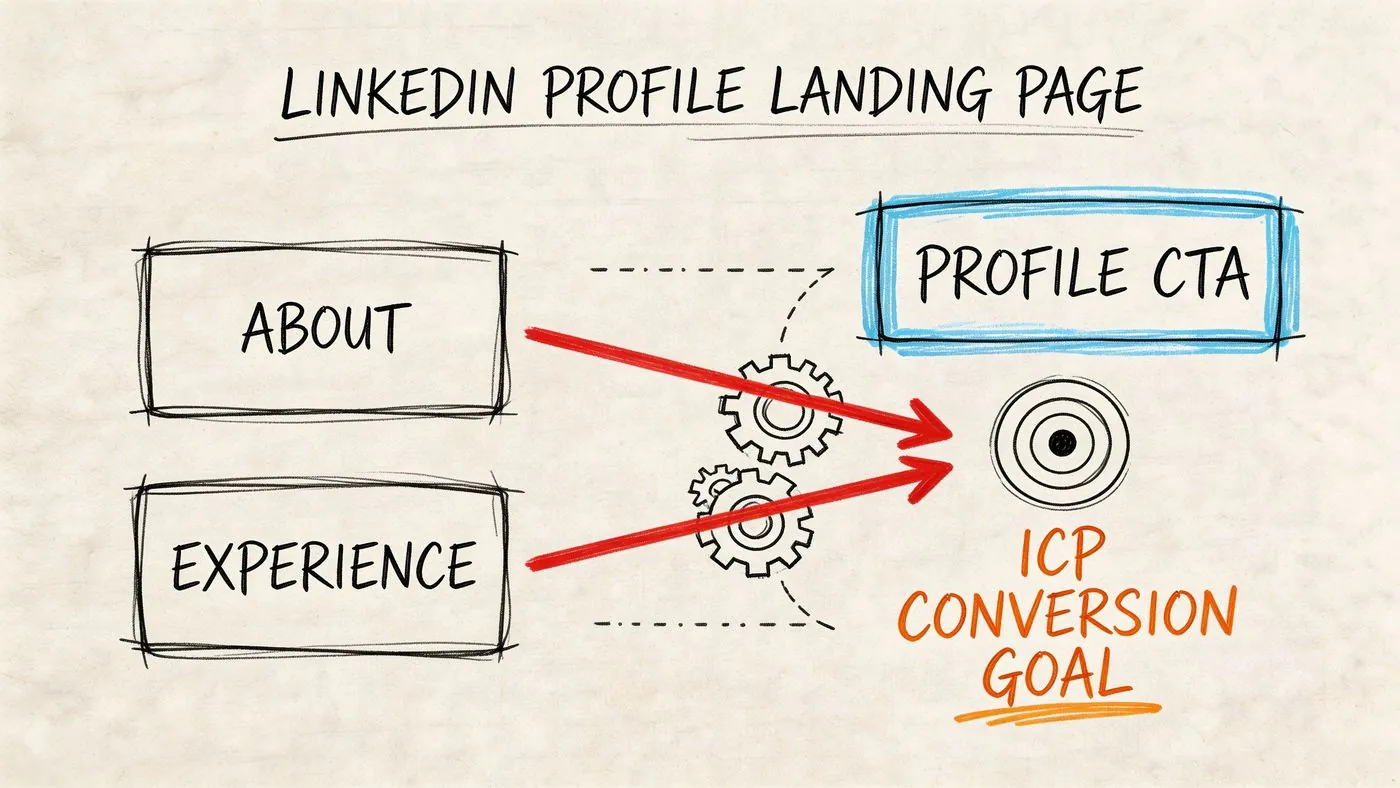
Your LinkedIn profile isn't a bio. It's a landing page with one job. Turn the right visitor into a conversation.
Many profiles fail because they read like a career archive. Buyers don't care that you’re “assionate about innovation” or “results driven.” They care whether you understand a problem they need solved.
Write a headline that does sales work
Your headline gets scanned before anything else.
Bad version:
- Generic identity: “Founder | Consultant | Speaker | Helping businesses grow”
Better version:
- Specific outcome plus audience: “I help B2B SaaS founders turn LinkedIn engagement into qualified sales conversations”
The second version does three things. It says who you help, what result you work on, and gives the reader a reason to keep scrolling.
If you serve multiple audiences, don't list all of them. Pick the audience that matters most to revenue right now.
Turn the About section into a buyer filter
The About section should sound like a sharp sales page, not a corporate mission statement.
A simple structure works well:
- Name the problem
- Describe the cost of ignoring it
- Explain your approach
- Show proof qualitatively
- Give a clear next step
Here’s the difference.
Weak About section
- Talks mostly about your background
- Lists traits instead of outcomes
- Uses vague phrases like “end to end solutions”
Stronger About section
- Starts with a buyer pain point
- Describes what changes after working with you
- Makes it obvious who should reach out and who shouldn’t
Example opening:
Many LinkedIn lead generation efforts fail because teams confuse visibility with buyer intent. We help B2B companies build targeted prospect lists, warm those prospects through content and comments, then turn that attention into conversations.
That opening positions expertise fast.
Use the Featured section like a deal acceleration layer
Many people underuse Featured.
Don’t fill it with random posts. Use it to answer the unspoken questions a prospect asks after clicking your profile.
Add assets like:
- A sharp offer page: What you do and who it’s for
- A practical lead magnet: Checklist, teardown, audit, or short guide
- A proof asset: Demo clip, client walkthrough, or process explainer
- A strong post: One that clearly explains your thinking and gets the right kind of engagement
The sequence matters. Put the clearest commercial asset first.
Experience should explain outcomes, not duties
Buyers skim your Experience section for relevance.
Don’t write it like a job description. Write it like a set of market facing capability statements.
Instead of this:
- Managed social media strategy across channels
Use this:
- Built LinkedIn outreach and engagement systems for B2B offers, including ICP targeting, content workflow, and follow up sequences
That tells a prospect how you think and what you can execute.
Content should support your sales motion
You do not need to become a full time creator to generate leads on LinkedIn.
You do need a repeatable content mix that supports trust.
A practical split looks like this:
| Content type | What it does | When to use it |
|---|---|---|
| Curated industry take | Shows judgment | When you want to stay visible without writing from scratch |
| Original lesson post | Builds authority | When you’ve learned something from live campaigns |
| Contrarian opinion | Creates discussion | When your market believes something sloppy or outdated |
| Process post | Qualifies buyers | When prospects need to understand how you work |
| Client question post | Surfaces pain | When sales calls keep revealing the same objection |
What to post if you're busy
If time is tight, don’t chase volume. Publish useful material that sales can build on.
A workable weekly rhythm:
- One insight post: A lesson from outreach, content, hiring, or pipeline work
- One response post: Your take on something happening in the market
- One conversion post: A post tied directly to a service, offer, resource, or call to action
Good LinkedIn content doesn't try to impress everyone. It gives the right buyer language for their problem and a reason to trust your approach.
Profile mistakes that hinder conversion
A few things consistently lower response quality:
- A headline full of buzzwords: Buyers can’t tell what you do.
- No pinned proof: Visitors have nowhere to validate your claims.
- Content that's too broad: You attract engagement from peers, not buyers.
- No call to action: Interested people don't know the next step.
- A resume tone: It sounds like you're applying for a job, not solving business problems.
When your profile and content are aligned, outreach gets easier. Prospects who check you out already understand the angle.
Advanced Prospecting to Find Your Ideal Buyers
The fastest way to waste LinkedIn is to send a decent message to the wrong list.
Many teams don't have a messaging problem first. They have a targeting problem. They build loose prospect pools, then blame response rates when the market ignores them.
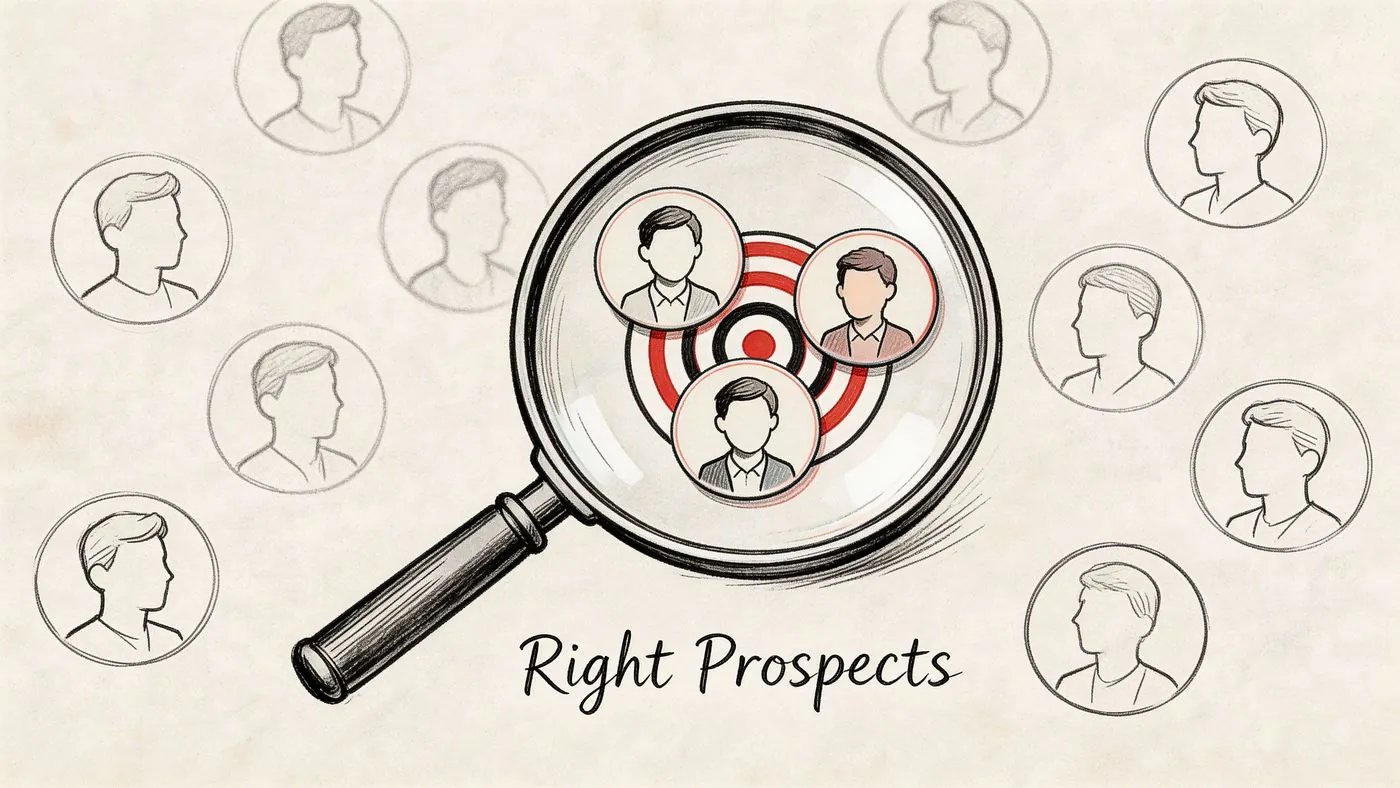
Cognism notes that broad lists yield a 2 to 5% response rate, while highly segmented ICP lists can achieve 15 to 25% response rates, and recommends using advanced filters, activity signals, data enrichment, and platform safe drip activity in the 50 to 100 actions/day range in this guide to LinkedIn lead generation.
Start with account logic, not contact logic
Many people begin by searching for individual leads.
That’s backward.
Start with the kind of company you want, then find the right people inside it. This is how you keep the list commercially relevant.
Build your search around:
- Company type: SaaS, agency, consulting, manufacturing, services
- Company size: Big enough to buy, small enough to move
- Geography: Relevant to your timezone, language, and sales coverage
- Buying situation: Teams likely to feel the problem you solve
- Commercial fit: Revenue model, maturity, hiring pattern, market focus
Once that’s clear, layer on contacts.
Go past job titles
Job title alone creates messy lists.
For example, “Head of Marketing” can mean a strategic buyer, a lone generalist, or someone with no budget authority. You need more context.
Useful filters often include:
- Seniority
- Function
- Headcount
- Industry
- Geography
- Recent activity
- Tenure or job change signals
One of the easiest ways to tighten your search is to monitor people who’ve been active recently. Someone who posted, commented, or changed roles is easier to engage than a dormant account.
Use intent signals, not just fit
Fit tells you who could buy. Intent tells you who’s more likely to care now.
That means watching for signals like:
- Posted in the last month
- Changed job recently
- Company hiring in relevant functions
- Engaging with creators in your category
- Talking publicly about problems you solve
This advantage allows LinkedIn to outperform generic list building tools. You can prospect based on behavior in a business context, not just static firmographics.
Boolean search is worth learning
Boolean logic looks technical, but it saves hours.
Use it to narrow by role language and remove noise. For example, if you sell to RevOps leaders, a search that accounts for “Revenue Operations,” “RevOps,” and adjacent variants will outperform a plain keyword query.
Good Boolean use helps when:
- Titles vary by company
- Your buyer has hybrid responsibilities
- You need to exclude recruiters, students, vendors, or agencies
- You’re monitoring creators and topics in the same niche
If you want to sharpen this part of your workflow, this breakdown of how LinkedIn search works and how to hack it is useful because it explains how search behavior affects targeting quality.
Build three prospect buckets
Not every lead deserves the same effort.
I like splitting lists into three buckets:
| Bucket | Who belongs there | How to treat them |
|---|---|---|
| Tier 1 | Strong fit and visible intent | Manual research, warm engagement, highly personalized outreach |
| Tier 2 | Good fit, weaker intent | Comment first motion, lighter personalization |
| Tier 3 | Possible fit but unproven | Monitor, nurture with content, don't push early |
That prevents a common mistake. Using expensive human effort on people who haven't earned it yet.
Use creator audiences as prospect pools
One underused move is prospecting through niche creators.
If your buyers regularly engage with specific voices in your space, those comment sections become live market maps. You can see who cares, what language they use, and which pain points keep appearing.
That gives you three advantages:
- Better vocabulary for your own comments and outreach
- Cleaner targeting because interest is visible
- A warmer entry point because you can engage around a shared topic
Here’s a useful explainer before you start building those lists:
Enrich before you outreach
Raw LinkedIn lists are rarely enough on their own.
Before you launch outreach, enrich the list with CRM data, website context, recent company news, and notes on what triggered inclusion. Even a short note like “hiring SDRs” or “founder posts about outbound” makes personalization easier later.
A smaller list with real intent signals usually beats a huge list built from job titles alone.
When you prospect this way, your engagement and messaging stop feeling random because the underlying list is already doing half the work.
The Engagement Playbook for Starting Conversations
Here is where most LinkedIn outreach goes wrong.
Someone builds a list, gets excited, and sends a pitch. No familiarity. No context. No reason for the other person to care. The message lands like interruption, because that’s exactly what it is.
The better approach is to warm the lead before you ask for anything.
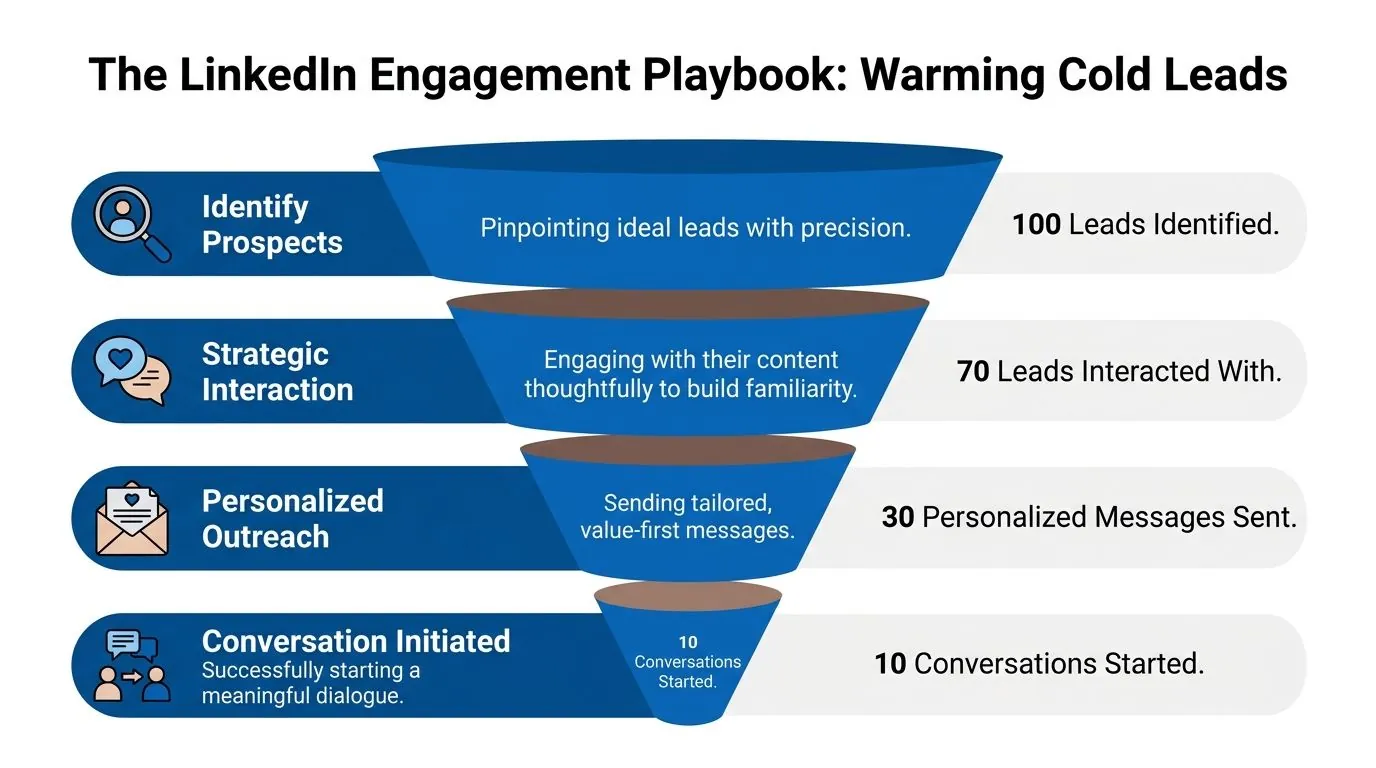
Martal reports that personalized connection requests that follow prior engagement can see 40 to 50% acceptance rates, while cold DM reply rates average 1 to 2% and can climb to 18% with strong personalization. It also notes that relationship first DMs achieve 15 to 25% response rates, with 30 to 50% of those converting to meetings, in its roundup of LinkedIn statistics for outreach and social selling.
Scenario one. The spammy version
A prospect posts about hiring challenges.
Within an hour, they get this:
Hi Sarah, I help companies like yours solve hiring bottlenecks with our end to end recruiting solution. Would love to book 15 minutes next week.
That message fails for obvious reasons. It ignores the post. It jumps straight to the seller’s offer. It sounds copied.
Scenario two. The version that starts conversations
Same prospect. Same post.
You leave a comment like:
Hiring usually breaks in two places first. Role clarity and response speed. If your team is seeing qualified candidates drop after the first touchpoint, that’s often the bottleneck before sourcing volume is.
That comment does real work. It adds an idea. It proves you read the post. It signals expertise without forcing a call.
A day later, the connection request says:
Hi Sarah, your post on hiring friction caught my eye. The point about speed was sharp. I work with teams dealing with similar bottlenecks, so I thought it made sense to connect.
That feels native to the platform.
Strategic commenting beats generic visibility
Many people comment ineffectively. They write “great post” or restate the original point in different words. That creates almost no commercial value.
Useful comments do one of four things:
- Add a nuance: Extend the idea with an operational angle
- Challenge politely: Offer a different view with respect
- Translate to execution: Show what the insight looks like in practice
- Ask a smart question: Move the conversation forward
Here are examples.
Weak comment
- Great post. This is so true.
Better comment
- The hard part isn't agreeing with this. It's operationalizing it. Many teams say they want quality leads, then reward reps for activity volume, which pushes behavior in the opposite direction.
Weak comment
- Totally agree.
Better comment
- I’d separate awareness from readiness here. A lot of buyers engage with the topic long before they want a demo, which is why comment first nurturing works better than pushing a call too early.
The comment should make the post author or their audience think, “This person understands the problem.”
A simple warm engagement sequence
You don't need a complex nurture machine to get started.
A practical sequence looks like this:
Identify a relevant post
Read the post and scan the comment section before writing anything.Leave one contextual comment
Add insight, not praise.Visit the profile
Check role, company, and recent activity so your next step isn't blind.Send a connection request
Reference the post or topic briefly.Follow up only if there’s context
Use the first DM to continue the conversation, not force a meeting.
Connection request templates that don't sound automated
Use short messages. Avoid pitches.
Template for a post based connection
Saw your post on onboarding friction. Strong point about handoff gaps between sales and CS. I work on adjacent problems in B2B growth, so sending a connection request.
Template for a creator audience connection
We keep crossing paths in the comments on RevOps posts. Your take on attribution trade offs was better than most. Thought I’d connect.
Template for a trigger based connection
Noticed the recent move into the VP role. That first quarter tends to surface process gaps fast. Thought it made sense to connect.
Follow up DMs that earn replies
The first DM should continue a thread. It should not feel like a trapped sales sequence.
Try structures like these.
Observation plus question
Thanks for connecting. You mentioned that pipeline quality matters more than lead volume right now. Is that showing up more in conversion rates or in rep efficiency?
Resource plus relevance
Appreciate the connection. You made a point about creators driving niche demand. I’ve been collecting examples of comment led engagement that opens warmer conversations. Happy to send them over if useful.
Pattern plus optional next step
Thanks for connecting. A pattern I keep seeing is teams posting solid content but missing the middle layer between engagement and outreach. If that’s something you're working through, happy to compare notes.
That last line matters. “Happy to compare notes” is lighter than “book time with me.”
What doesn't work anymore
Some moves are still common and still weak.
- The instant pitch: You connect and immediately ask for a meeting.
- The fake compliment: Empty praise before a canned offer.
- The long intro: Too much context before the prospect knows why it matters.
- The hard CTA: “Are you free Thursday at 2?” before interest exists.
- The generic follow up: “Just bumping this to the top of your inbox.”
If your DM could be sent to anyone, it will usually be ignored by everyone who matters.
Use comments to earn the right to message
The cleanest LinkedIn conversations usually start in public.
A prospect sees your name more than once. They notice your comments are relevant. They click your profile and it makes sense. Then your connection request arrives and it feels expected, not intrusive.
That sequence is slower than mass blasting. It’s also far more durable.
Scaling Your Outreach with Smart Automation
Manual LinkedIn work is high quality, but it doesn't scale well on its own. Pure automation scales, but it often destroys trust when people use it carelessly.
The useful middle ground is simple. Automate repetition. Keep judgment human.
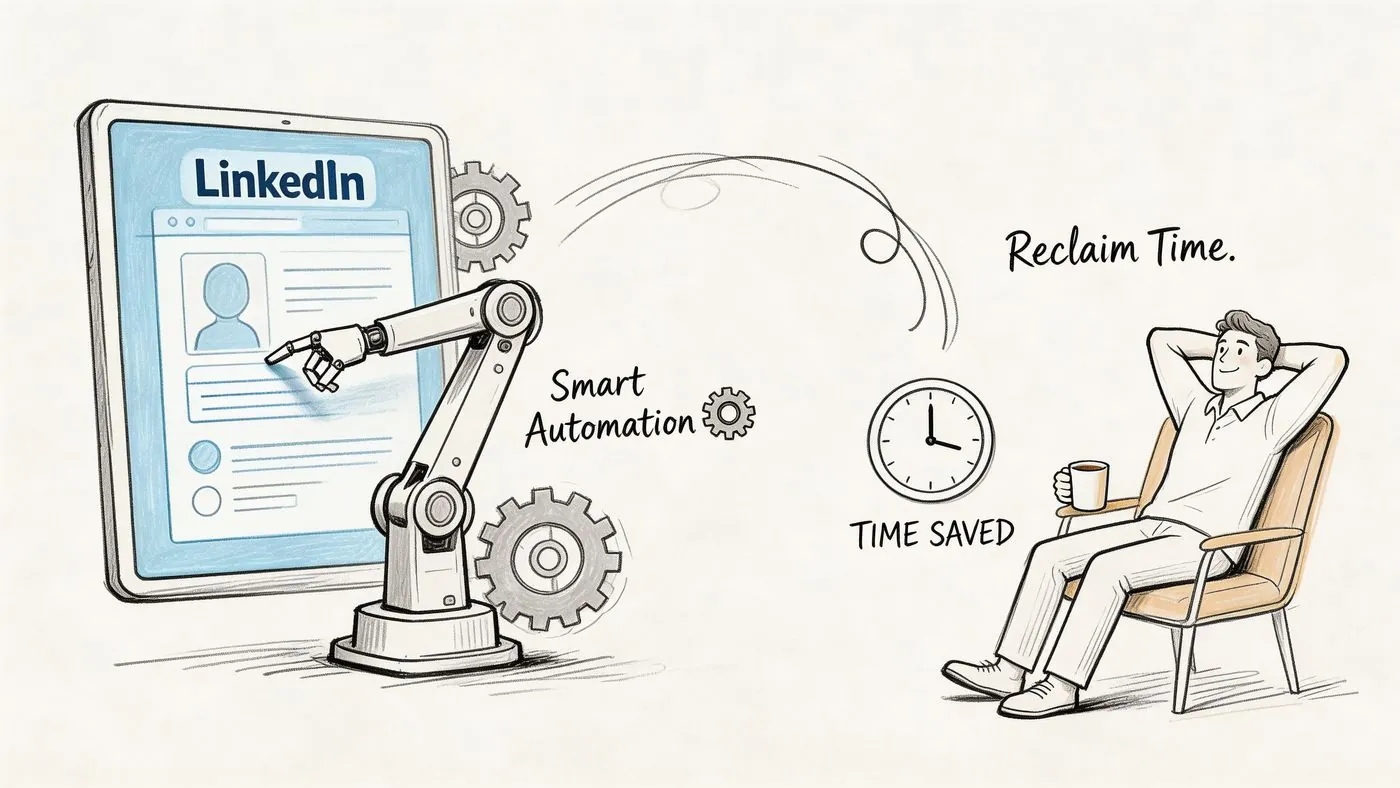
Leadspicker notes that strong automation workflows combine targeted lists, on platform Lead Gen Forms, and sequenced actions with daily limits. It also reports that Lead Gen Forms average a 13% completion rate, while poor timezone targeting can reduce responses by 40% and weak personalization can drop response rates by 25%, based on its guide to master LinkedIn lead generation.
What should be automated
Automation works best on tasks that are repetitive, rules based, and easy to review.
Good candidates include:
- List imports and segmentation: Pulling Sales Navigator lists into a workflow
- Connection sequencing: Sending requests and follow ups within reasonable limits
- Lead capture: Using native Lead Gen Forms for paid campaigns
- Monitoring activity: Tracking keywords, creators, and fresh posts
- Comment drafting for approval: Generating contextual first drafts you can review
Bad candidates include nuanced sales conversations, objection handling, and anything that needs real empathy or strategic judgment.
The safest model is hybrid
Teams getting steady results usually split work like this:
| Layer | Best handled by | Why |
|---|---|---|
| Prospect discovery | Tool plus human review | Speed without sloppy targeting |
| Post monitoring | Tool | Humans won't catch everything in time |
| First pass commenting | Tool with approval option | Maintains consistency while preserving quality |
| High value DMs | Human | Context and tone matter most here |
| Meeting conversion | Human | Trust either compounds or breaks at this stage. |
Where AI commenting fits
Commenting is one of the hardest motions to sustain manually because timing matters and the work is repetitive. If you're tracking niche creators or keyword based conversations, AI can help surface posts and draft contextual replies faster than a person can do all day.
One option is to use tools that monitor targeted creators and relevant keywords, then generate comments for approval or direct posting within your operating limits. If you want another example of how AI tools are being used to structure repetitive digital workflows, you can explore the lunabloomai app for a separate use case around AI assisted task execution.
For LinkedIn specifically, PowerIn’s automated LinkedIn outreach guide is a practical reference on where automation belongs and where it doesn't. PowerIn monitors keywords and creators, drafts contextual comments, supports manual approval, and works within LinkedIn usage limits, which makes it better suited to top of funnel engagement than to fully automated sales conversations.
Automation should create more relevant touchpoints, not more noise.
Rules that keep automation useful
Three rules matter more than the tool brand.
- Respect daily limits: Aggressive automation is usually what gets accounts into trouble.
- Match timezone and language: A good message sent at the wrong time or in the wrong tone loses force.
- Review your prompts and templates: If outputs start sounding generic, performance falls fast.
You also need escape hatches. Manual approval, history logs, and CSV exports matter because they let you audit quality instead of guessing.
Automation should free your best work
The payoff isn't “doing more outreach.”
The payoff is protecting your time for the parts machines still handle badly. Better prospect research. Better offers. Better conversations. Better qualification after someone replies.
Used that way, automation doesn't replace relationship building. It protects it.
Sample Workflows for Your Role
LinkedIn lead generation changes depending on what job you’re trying to do. A founder doesn’t need the same motion as an SDR. A recruiter shouldn’t copy a demand gen marketer.
That’s why generic advice falls apart in practice.
Here’s a cleaner way to think about it.
LinkedIn lead gen plays by role
| Role | Primary Goal | Key Tactic | Top Metric |
|---|---|---|---|
| Founder | Build authority and open qualified conversations | Post opinionated market insights, comment on buyer and partner discussions, then reply manually to inbound interest | Qualified conversations started |
| SDR | Create steady meeting flow | Work from segmented account lists, warm target prospects through activity based engagement, then send short personalized outreach | Meetings booked |
| Marketer | Capture demand from content and campaigns | Pair thought leadership with Lead Gen Forms, event promotion, and retargetable engagement | Marketing qualified leads |
| Recruiter | Build talent pipelines and candidate replies | Engage with niche professionals around career topics, hiring signals, and relevant creator content | Candidate conversations |
| Consultant or coach | Turn expertise into discovery calls | Use educational posts, comment led visibility, and profile CTAs tied to a focused offer | Discovery calls booked |
What founders should do differently
Founders often make one of two mistakes. They either outsource everything and lose their voice, or they post a lot without connecting content to pipeline.
The better move is to stay personally visible on key topics your buyers already care about. Then use comments and selective outreach to turn authority into conversation.
If you’re a founder, your name often converts better than your company page.
What SDRs should do differently
SDRs need consistency more than creative expression.
That means tight segmentation, a reliable engagement sequence, and messaging that references visible context. SDRs usually get in trouble when they prioritize action volume over list quality.
A smaller, cleaner list with strong context will usually outperform a giant list full of weak fits.
What marketers should do differently
Marketers should think in journeys, not isolated posts.
A post, comment, ad, or lead form shouldn’t operate alone. Each touchpoint should move the prospect one step closer to an identifiable action, whether that’s a form fill, event signup, or conversation with sales.
If you’re building this stack, it helps to review categories of LinkedIn lead generation tools so you can separate prospecting tools, outreach tools, and engagement tools by job to be done.
What recruiters should do differently
Recruiters shouldn’t borrow sales language.
Candidate conversations start faster when your comments and messages show understanding of role transitions, career timing, hiring process friction, and what strong candidates want to know before they reply.
Good recruiting outreach feels informed. Bad recruiting outreach feels like scraping.
Measuring What Matters and Scaling Your Success
Likes don't build pipeline by themselves.
If you want LinkedIn to become a repeatable lead channel, measure the steps that lead to conversations. Everything else is supporting data.
The most useful dashboard is boring on purpose. It tracks movement through a simple funnel.
Track the middle, not just the outcome
Many individuals only look at two points. Impressions at the top and meetings at the bottom.
That leaves a blind spot in the middle where most of the influence lives.
Track things like:
- Profile views from target accounts
- Connection acceptance rate
- Reply rate by message type
- Meetings booked from warm outreach
- Lead source by content theme
- Comments that lead to profile visits or DMs
That last one matters more than many teams realize.
Outfunnel highlights a major gap in LinkedIn strategy: comment engagement is often ignored even though timely, contextual comments matter. It reports that tools automating human sounding replies on monitored posts can boost profile visits by 40%, and that 70% of leads ignore generic comments, favoring comments that add value, in its analysis of LinkedIn lead generation.
Build a simple comment tracking loop
You don't need fancy attribution to learn from comments.
Start with a lightweight process:
Log where you commented
Note creator, topic, and audience relevance.Tag the comment style
Was it a challenge, an insight, a question, or a tactical addition?Watch for downstream signals
Profile views, connection requests, replies, and inbound DMs.Compare patterns
Which topics and comment types pull the right people in?
Through this process, many LinkedIn programs become sharper. They stop treating comments as engagement theater and start treating them as measurable top of funnel actions.
Generic engagement creates activity. Specific engagement creates identifiable buyer movement.
Scale by tightening, not by spraying
Once you know what works, resist the urge to expand too fast.
Instead:
- Double down on high signal creators
- Keep refining your ICP segments
- Retire weak message templates
- Reuse comment angles that attract qualified visitors
- Send more manual follow ups to warmer responders
That’s how to generate leads on linkedin without turning your account into a spam machine. Better targeting, clearer signals, tighter loops.
If you want help turning comment led visibility into a real prospecting system, PowerIn is built for that layer. It monitors targeted keywords and creators, generates contextual comments, and helps teams stay consistently visible while keeping manual effort focused on the conversations that matter most.