Searching for the best linkedin summary examples? You've probably noticed the good ones do more than just list job duties. The most powerful summaries are personal, tell a compelling story, and grab your attention right from the first line. They act as a digital handshake, introducing who you are, who you help, and why someone should want to know you.
Why Your LinkedIn Summary Is Your Digital Handshake
Think of your LinkedIn 'About' section as the most valuable real estate on your profile. Too many people treat it like a dusty, formal bio, but it's really your 24/7 salesperson working in a room of over a billion professionals. It's your digital handshake: the first real impression you make, establishing your credibility long before you ever connect.
The sheer scale of LinkedIn makes a strong first impression non negotiable. The platform is on track to have over 1.15 billion users by 2025, cementing its place as the world's B2B networking hub. Every single day, your summary is being scanned by prospects, recruiters, and future collaborators. It’s no longer just an option; it's your most critical tool for standing out.
From Static Bio to a Dynamic First Impression
A great summary pulls the right people in. It’s what transforms your profile from a passive resume into a dynamic pitch that immediately answers a visitor's most important question: "How can this person solve my problem?" This is your chance to frame your expertise and set the stage for everything else they'll see on your profile.
A well written summary will do three things for you:
- Build Instant Credibility: It quickly shows you know what you're talking about.
- Capture Attention: A strong opening hook makes people want to click "see more" and learn your story.
- Drive Action: It clearly tells people the next step, whether that’s sending a connection request, visiting your website, or booking a call.
The table below breaks down how different parts of your profile contribute to that first impression, but you'll notice the summary carries the most weight in those first critical seconds.
How Profile Sections Influence First Impressions
| Profile Section | Primary Purpose | Audience Attention Span | Impact on Credibility |
|---|---|---|---|
| Headline | Quick Identifier | 1 to 2 Seconds | Moderate |
| Summary/About | Story & Value Prop | 5 to 10 Seconds | High |
| Experience | Proof of Work | 10 to 20 Seconds | High |
| Recommendations | Social Proof | Varies | Very High |
As you can see, while every section matters, your summary is where you have the best opportunity to tell your story and establish your value before a visitor decides to scroll further or click away.
This section is the foundation of your professional brand on the platform. For a deeper dive into building a cohesive personal brand, this LinkedIn Personal Branding Guide offers some fantastic insights.
The Foundation of Your Professional Story
At the end of the day, your summary is where you get to show what makes you different beyond a simple job title. It’s your opportunity to speak directly to your target audience (be it potential clients, employers, or partners) in your own authentic voice.
When you blend your personality with your professional wins, you create a memorable narrative that sticks. This is so fundamental that it's a key step in learning how to become a LinkedIn Top Voice and building real influence. Without a compelling summary, you’re just another face in the digital crowd.
The ABCD Framework for a Killer LinkedIn Summary
That blinking cursor in your LinkedIn "About" section can feel pretty intimidating, right? It's your one big shot to make an impression, but most people either freeze up or just list a few job titles.
Instead of staring at a blank screen, let’s walk through a simple, four part framework I call ABCD. It’s not about following a rigid template; it’s about making sure your summary does its job: grabbing attention, telling your story, proving your worth, and guiding the reader to the next step.
A is for Attention
You’ve got about two lines. That’s it. On most screens, that’s all anyone sees before they have to click “see more.” If those first couple of sentences don’t immediately hook them, they’ll just scroll on by.
This is your headline, your opening act. It needs to speak directly to the person you want to attract. Forget the generic fluff.
- What most people write: "I am a skilled B2B sales leader with a demonstrated history of..."
- What you should write: "I help SaaS founders cut through the noise and land their first 100 enterprise customers, without a massive marketing budget."
See the difference? The second one isn't about you; it’s about them. It instantly tells a specific audience (SaaS founders) how you solve their biggest problem.
B is for Background
Okay, you’ve hooked them. Now, it’s time to give them a reason to trust you. This is where you tell your story, but not in a boring, chronological way. Your "Experience" section already lists your jobs. Your summary needs to connect the dots.
Share the "why" behind your career. What’s your mission? Was there an "aha" moment that set you on your current path? This is your chance to be human and build a real connection. Think of it as the start of a conversation, not a recital of your resume.
Your summary is your chance to explain the "why" behind your resume. It should feel like the beginning of a conversation, not a dry recitation of your career history.
This narrative gives context to your skills and makes you memorable. When a prospect or recruiter lands on your profile, this is the part that builds the bridge from a simple profile view to actual credibility.
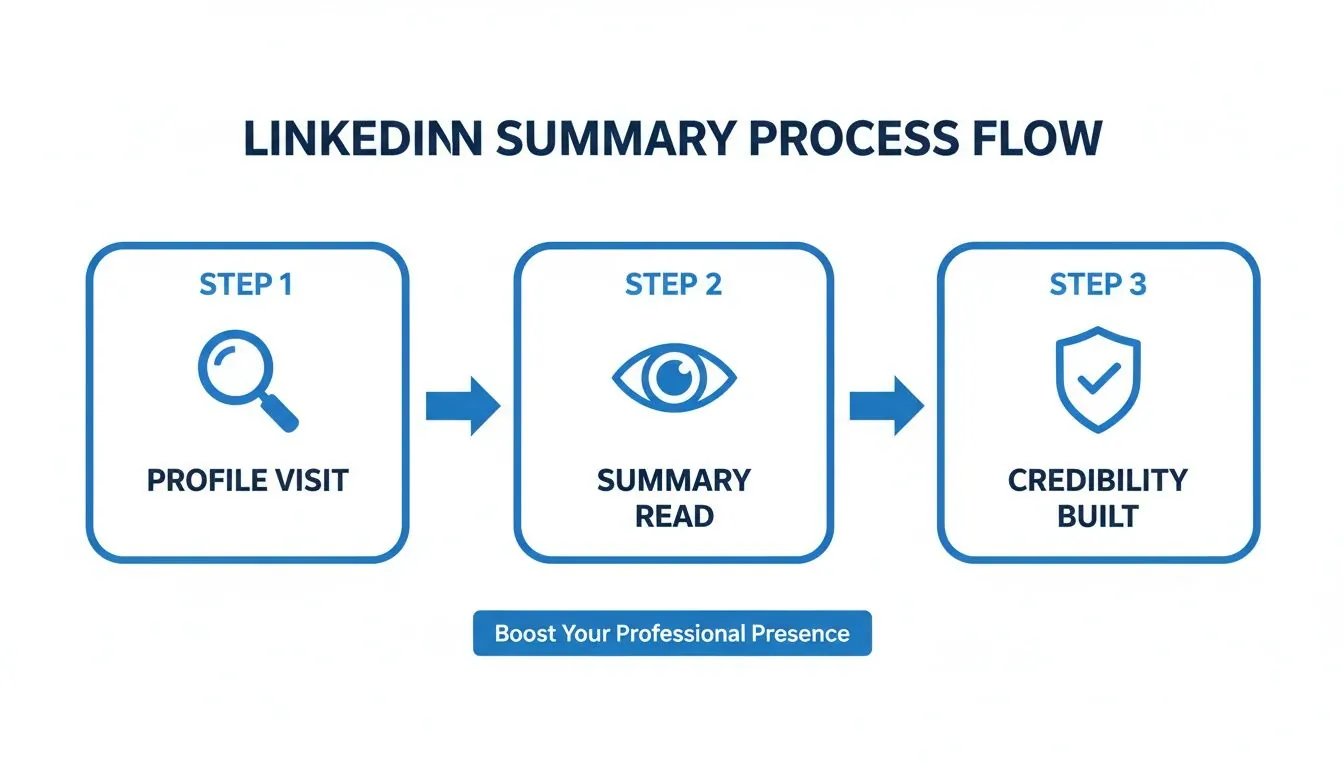
As you can see, your summary is the critical piece that turns a casual visitor into an interested prospect.
C is for Credibility
You've made a promise with your attention grabbing opener and shared your story. Now you have to prove you can actually deliver. This is where you back up your claims with hard evidence.
Talk is cheap. Results are everything. Use concrete numbers and specific outcomes to show what you can do.
- Vague Claim: "Helped increase team efficiency."
- Credible Proof: "I rolled out a new project management workflow that cut our project delivery times by 25% and boosted team output by 15%, all within six months."
Numbers don't lie. You can also sprinkle in a short client testimonial or mention a key award. This kind of social proof is incredibly powerful because it’s someone else vouching for your expertise.
D is for Direction
You've done all the hard work. You got their attention, told your story, and proved your value. Don't just let the conversation end there! The biggest mistake you can make is not telling them what to do next.
A summary without a clear call to action (CTA) is like a sales pitch with no "buy" button. Be direct. Guide them to the action you want them to take, whether it's for sales, networking, or finding a job.
Here are a few linkedin summary examples of strong CTAs:
- For Lead Generation: "If you're looking to scale your B2B sales, send me a message or book a discovery call here: [Your Link]"
- For Networking: "I'm always open to connecting with fellow marketing professionals. Feel free to send a connection request."
- For Job Seekers: "I am currently exploring new opportunities in product management and can be reached at [your.email@email.com]."
Alright, we've covered the theory. Now, let's get our hands dirty and see what this looks like in the real world. Knowing the formula is one thing, but seeing it come to life in proven examples is what really makes it click.
This isn't just a list of templates to copy and paste. Think of it as a playbook. We’re going to dissect over 30 winning LinkedIn summaries, organized by role, and I’ll break down exactly why they’re so effective. Find the one that feels closest to your own work, borrow the structure, and make it your own.
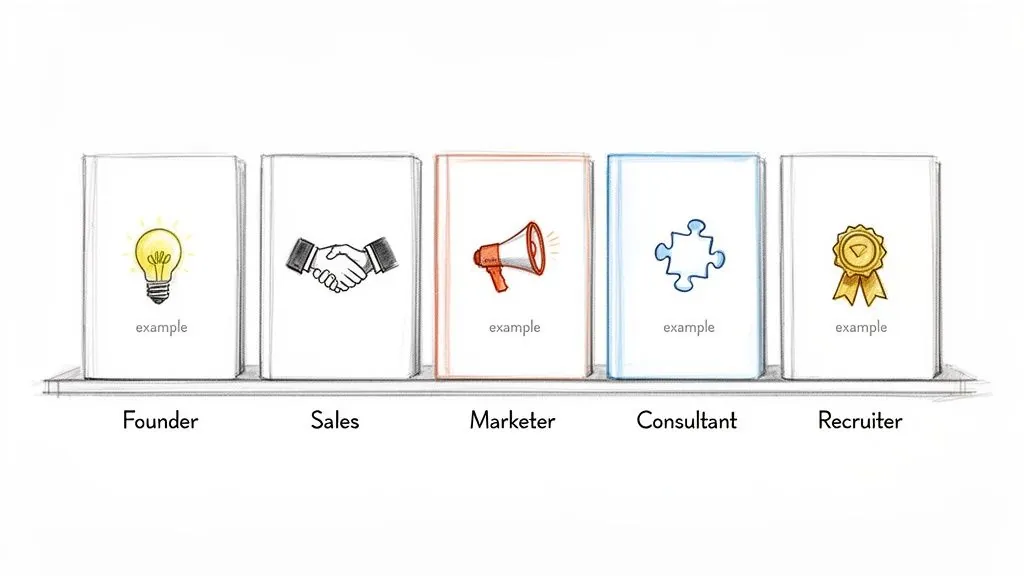
LinkedIn Summary Examples for Founders
As a founder, you're not just selling a product: you're selling a vision. Your summary has to inspire confidence, attract the right talent, and intrigue potential investors. The best founder profiles weave together genuine passion with undeniable proof.
Example 1: The Visionary Storyteller
"I believe the future of B2B sales isn't about more cold calls; it's about smarter conversations. When I started my first company, I spent 80% of my day on manual outreach that went nowhere. I knew there had to be a better way.
That's why I built [Your Company Name], an AI powered platform that helps sales teams have contextual, relevant conversations at scale. We're not just building another tool; we're giving teams their time back to focus on what matters, building relationships.
In just two years, we've helped over 5,000 B2B professionals triple their engagement rates and cut prospecting time in half.
Want to see how we're changing the game? Let's connect. I'm always open to sharing insights with fellow founders and sales leaders."
Why It Works
This summary is so effective because it tells a story, not just a sales pitch. It immediately grabs your attention by challenging an industry norm, then builds a personal connection with a relatable origin story. The statistic (5,000 professionals helped) lends instant credibility, and the call to action feels like a genuine invitation to network, not a hard sell.
LinkedIn Summary Examples for Sales Professionals
For a salesperson, your summary is your opening pitch. It has to instantly frame you as a problem solver, not just another person trying to sell something. The most compelling sales summaries dive right into the customer's world and are packed with tangible results.
Example 2: The Results Driven Problem Solver
"I don't sell software. I help SaaS companies solve their customer retention problem. Too many businesses lose revenue not because their product is bad, but because their onboarding is broken.
My passion is helping clients build scalable onboarding processes that turn new users into lifelong advocates. By focusing on user value from day one, I've helped my clients reduce churn by an average of 30% within the first six months.
Some of my proudest achievements include:
• Designing a retention strategy that saved a Series B startup $1.2M in its first year.
• Guiding a client to a 45% increase in user activation rates.
• Consistently exceeding my quota by over 150% for eight consecutive quarters.If you’re struggling to keep the customers you worked so hard to win, let's talk. Send me a connection request or email me at [your.email@email.com]."
Why It Works
The opening line, "I don't sell software", is a brilliant hook that immediately separates this person from the crowd. The summary demonstrates a deep empathy for a critical business problem (churn) before ever mentioning a solution. The bullet points are pure gold; they showcase concrete, dollar and cent results ($1.2M saved, 30% churn reduction) that prove this person delivers value. The final CTA is direct, confident, and offers multiple ways to get in touch.
LinkedIn Summary Examples for Marketers
A marketer's summary is their own best ad. It has to be a masterclass in branding and communication, proving they can command attention and drive real business growth. It's their chance to show, not just tell, their expertise.
Example 3: The Strategic Growth Marketer
"In a world of endless content, the only thing that matters is resonance. My job is to make brands unforgettable. I'm a growth marketer who specializes in turning B2B tech companies from unknown players into industry leaders.
I combine data driven SEO with compelling storytelling to build marketing engines that generate predictable pipeline. My philosophy is simple: create content so valuable that your audience would pay for it.
For my last client, I led a content strategy that:
• Grew organic traffic by 400% in 12 months.
• Generated over $3M in attributable pipeline.
• Secured features in Forbes and TechCrunch.Specialties: SEO, Content Marketing, Demand Generation, Product Marketing, B2B SaaS.
Open to connecting with marketing leaders and founders in the tech space. Let's share strategies!"
Why It Works
This summary reads like it was written by a top tier marketer. It starts with a strong point of view on marketing itself, establishing expertise. The philosophy, "create content so valuable that your audience would pay for it", is memorable and powerful. The results are nothing short of spectacular (400% traffic growth, $3M pipeline), and including a "Specialties" section is a smart move for LinkedIn's search algorithm.
LinkedIn Summary Examples for Consultants
A consultant's LinkedIn profile is their digital storefront. The summary has to build trust in a heartbeat, positioning them as an undeniable expert while clearly explaining the value they bring. It needs to be sharp, confident, and laser focused on results.
Example 4: The Expert Advisor
"CEOs don't hire me to tell them what they want to hear. They hire me to find the blind spots in their operations that are costing them millions.
For over 15 years, I've helped mid market manufacturing companies streamline their supply chains and unlock hidden efficiencies. I embed with your team to diagnose core issues, redesign workflows, and implement changes that stick.
The result? My clients typically see a 15 to 20% reduction in operational costs and a 10% increase in production output within one year.
If you suspect your operations could be more efficient, you're probably right. I offer a complimentary 30 minute diagnostic session for qualified companies. Book a time on my calendar here: [Your Link]"
Why It Works
What a fantastic opening. It’s provocative and instantly establishes authority. This consultant clearly defines their niche (mid market manufacturing) and their hands on process, which builds trust. Providing a specific, believable range of results (15 to 20% cost reduction) is much more powerful than a vague promise. The final call to action is a masterstroke: offering a free, high value diagnostic session with a direct booking link is a low friction way to start a sales conversation.
Your LinkedIn Summary: Making It Both Searchable and Compelling
Your LinkedIn summary has two critical jobs. It needs to tell a compelling story that makes people want to connect with you, but it also has to speak the language of LinkedIn's algorithm so the right people can find you in the first place.
Think of it this way: storytelling is what builds trust and makes you memorable. Keywords are the signposts that guide your ideal audience directly to your profile. A profile without keywords is like a brilliant speech given in an empty room. On the flip side, a summary stuffed with jargon and keywords but no personality feels robotic and pushes people away. You need both.
How to Speak the Language of LinkedIn SEO
At its core, LinkedIn is a massive search engine for professionals. When a founder searches for a “Fractional CMO specializing in lead generation,” or a recruiter looks for a “B2B Sales Director with SaaS experience,” the platform scans millions of profiles for those specific terms. Your summary is one of the most important pieces of real estate the algorithm looks at.
This is where a smart keyword strategy comes in. Your mission is to get inside the head of your target audience and use the exact words they're typing into the search bar. If you really want to get into the nitty gritty of the algorithm, it's worth exploring how LinkedIn search works and how to hack it.
To get started, brainstorm your top 3 to 5 core keywords. They usually fall into these categories:
- Job Titles: "Product Manager," "Software Engineer," "Account Executive."
- Core Skills: "Demand Generation," "Supply Chain Optimization," "Agile Methodologies."
- Industry Niches: "FinTech," "Healthcare IT," "B2B SaaS."
The secret isn't just listing them. It's about weaving them naturally into your professional story.
Weaving Keywords into Your Narrative
Here’s where most people go wrong. They treat their summary like a resume and just list their skills. It might be keyword rich, but it's completely devoid of personality.
Before: The Keyword Stuffed Summary
"Experienced digital marketing manager with a background in SEO, content marketing, and PPC advertising. Skilled in lead generation and email marketing automation for B2B tech companies. Proven ability to drive website traffic and improve conversion rates."
Technically, it checks the boxes for the algorithm. But it’s dry, boring, and fails to make any real human connection. It reads like it was written by a machine.
Now, let's infuse that with a story while keeping the same essential keywords.
After: The Story Driven Summary
"I believe the best marketing doesn't feel like marketing at all. As a digital marketing manager, my passion is helping B2B tech companies build relationships with their customers through valuable content. I use a data driven approach, combining strategic SEO and targeted PPC advertising to connect with audiences who need our solutions.
My focus is on building a full funnel engine that drives real results, from boosting website traffic with high quality content marketing to nurturing leads with sophisticated email marketing automation. This strategy has consistently powered our lead generation efforts and improved conversion rates by over 30% year over year.
If you're looking to build a marketing function that values storytelling and drives growth, let's connect."
See the difference? The second version shares a philosophy, proves its points with a metric, and uses keywords to add context to a compelling narrative. It connects with both the algorithm and the human on the other side of the screen.
With LinkedIn projected to have over 1.3 billion members by 2026, and since the platform accounts for 75 to 85% of B2B leads from social media, a well crafted summary is non negotiable.
Once your profile summary is dialed in, it’s time to think about how it fits into your broader presence. The next step is building an effective LinkedIn content strategy that builds on this strong foundation.
4 Common Mistakes That Make Your LinkedIn Summary Invisible
Your LinkedIn summary can be an absolute magnet for the right opportunities, but a few common missteps can make it completely invisible. It's not just about what you say, but also what you don't say, and how you say it.
So many professionals accidentally sabotage their own profiles with simple, fixable mistakes. Think of your summary as the front door to your professional brand. If it’s cluttered, confusing, or locked, nobody is going to try to get inside. Let's walk through the most common errors I see and how to fix them, fast.
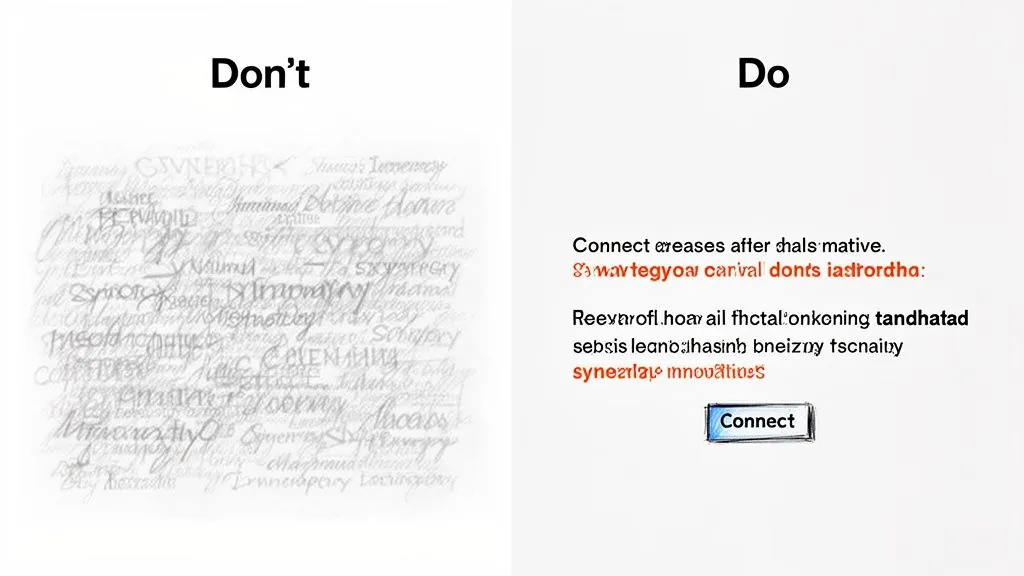
1. Writing in the Distant Third Person
This is one of the quickest ways to create a disconnect. When you write about yourself as if you're not in the room, it feels stuffy, formal, and oddly impersonal. People connect with people, not with biographical entries.
- Don't Do This: "John is a results driven sales professional with over ten years of experience. He consistently exceeds targets and is a strategic thinker."
- Do This Instead: "As a sales professional, I'm genuinely passionate about helping my clients succeed. For the past ten years, my focus has been on building relationships that drive real results. I believe in..."
Writing in the first person ("I," "my," "we") feels authentic and direct. It’s like you're having a real conversation with the person reading your profile, which is exactly the point.
2. Forgetting a Clear Call to Action (CTA)
So you've hooked them with a great story and showcased your value... now what? A summary that just trails off at the end is a massive missed opportunity. You've done all the hard work to get their attention, but you haven't told them what to do with it.
- Don't Do This: End your summary with a list of skills and then... radio silence.
- Do This Instead: "I'm always open to connecting with fellow marketing leaders. Feel free to send a connection request or email me at [your.email@email.com] to talk strategy."
Tell visitors exactly what you want them to do next. Whether it's connecting with you, visiting your company's website, or sending you a note, a simple CTA turns passive readers into active leads.
Your LinkedIn summary isn't just a biography; it's the start of a conversation. A strong call to action is your invitation for others to join in.
3. Creating an Unreadable "Wall of Text"
Nothing makes a reader's eyes glaze over faster than a dense, unbroken paragraph. People don’t read online; they skim. Huge blocks of text are intimidating and get skipped entirely, especially on a mobile screen.
Break it up! Use simple formatting to make your summary easy to scan:
- Keep your paragraphs short: 1 to 3 sentences is a good rule of thumb.
- Use bullet points or numbered lists for skills, accomplishments, or services.
- Embrace white space. It gives your words room to breathe and your reader's eyes a place to rest.
With LinkedIn's user base exploding over the years, growing from a $7.8 billion market cap in 2011 to $22.6 billion by 2022, the competition for attention is fierce. With a typical engagement rate hovering around 3.8%, you can't afford to be ignored. You can find more fascinating LinkedIn statistics and see the platform's incredible growth in this comprehensive report on Backlinko.com.
4. Relying on Empty, Meaningless Buzzwords
Words like "strategic," "passionate," "motivated," and "innovative" have been used so much they've lost all meaning. They are just filler. Instead of making you stand out, they make you sound exactly like everyone else.
The fix is simple: show, don't tell. Instead of just saying you're a strategic thinker, give a quick example of a strategy you developed and the amazing results it produced. Proof is always more powerful than platitudes.
Turn Your Profile Views into Conversations
Getting your profile summary just right is a huge step, but it’s only laying the groundwork. A killer summary gets people to your profile, but an intelligent engagement strategy is what turns those curious visitors into actual conversations and, down the line, qualified leads.
Think of it this way: your optimized profile is your digital home base. Every post you share and every comment you leave is an invitation for someone to stop by. When they do, your summary is there to welcome them and prove you know your stuff. The goal is to get a flywheel going: your engagement drives traffic to your profile, and your profile turns that traffic into real business opportunities.
From Static Profile to Active Pipeline
The most successful B2B pros on LinkedIn don't just set up a great profile and wait for the magic to happen. They're out there every day, actively jumping into relevant discussions. This is the secret to bridging the gap between having a static, billboard like profile and building a dynamic, active pipeline.
This is exactly how you shift from being a passive observer to an active participant in your industry's conversations.
That screenshot from the PowerIn homepage shows what this looks like when you build a system around it. The whole idea is to post insightful, contextual comments that consistently put your expertise on display, funneling interested prospects right back to your profile. It’s the engine that connects your polished summary to a pipeline that actually generates results.
Turning Engagement into Opportunity
Every thoughtful comment you drop on a post is like a mini advertisement for your brain. When you consistently add value to conversations happening in your niche, people can't help but notice. They get curious, click on your profile to see who you are, and that's when your powerful summary, backed by the numerous linkedin summary examples in this guide, closes the loop.
Your profile summary is the destination, but your daily engagement is the vehicle that gets people there. Without a consistent presence in your network’s feed, even the best summary will go unseen.
This is a system that works. Your activity creates the initial spark of interest, and your summary provides the substance they need to start trusting you and reach out. For a deeper look at this strategy, our article on how commenting on LinkedIn boosts visibility breaks down how to make every interaction count.
Combine a great summary with a smart engagement strategy, and you’ve built a powerful, scalable machine for growing your network and generating leads 24/7.
Your LinkedIn Summary Questions Answered
You’ve scrolled through dozens of LinkedIn summary examples, but when it comes to your own profile, a few nagging questions always seem to pop up. That’s completely normal. Getting these final details right can feel like the hardest part.
Let's tackle the big ones I hear all the time so you can stop second guessing and start writing with confidence.
How Long Should My LinkedIn Summary Be?
There’s a sweet spot here. You need enough meat to be interesting, but not so much that you put people to sleep. Skimmers are everywhere.
A good rule of thumb is 3 to 5 short paragraphs, which usually lands you in the 150 to 300 word range. This is the perfect length to hook someone, share your core story, and back it up with a little proof, all while being easy to read on a phone. Always remember, impact beats length every time.
Should I Use the First or Third Person?
This one’s easy: first person, always. Use "I" and "my." Your LinkedIn profile is your professional handshake, the start of a potential conversation. Writing in the first person makes you sound direct, human, and instantly relatable.
Writing in the third person ("John is a skilled marketer...") creates a weird, formal distance. It’s like you hired a biographer to write your profile. The first person ("I help brands...") feels authentic and makes you far more approachable.
How Many Keywords Should I Include?
Keywords are how the right people find you, but stuffing them in makes you sound like a robot. The trick is to weave them in so naturally that a human reader never notices, but the LinkedIn algorithm does.
Think of it this way:
- Pick your top 3 to 5 keywords. These are the non negotiable terms for your role and industry (e.g. "B2B SaaS Sales," "Content Marketing Strategy," "Supply Chain Logistics").
- Work them in naturally 2 to 3 times each. Don't force it.
- Sprinkle in synonyms and related phrases. This helps you avoid sounding repetitive and catches a wider net of searches.
What Is the Most Important Part of the Summary?
Your first two lines. That’s it. On most screens, this is all anyone sees before they have to click "...see more."
If that opening doesn't immediately grab their attention, you've lost them. No one clicks to read a boring intro. Use this precious space to hit them with who you help, what problem you solve, and why you’re the one to do it. Make it impossible for them to scroll away.
Ready to turn those profile views into a steady stream of leads? PowerIn uses AI to post high quality, contextual comments on LinkedIn and X, attracting prospects around the clock. Start your 5 day free trial and discover how automated engagement can accelerate your growth.