Ever wondered how some LinkedIn posts rack up a dozen comments just minutes after being published? The secret often isn't a viral masterpiece, but something a bit more orchestrated: a LinkedIn pod.
Simply put, a LinkedIn pod is a private group of people who agree to like and comment on each other's posts. Think of it as a small, coordinated team whose sole purpose is to create a burst of initial engagement, hoping to signal to the LinkedIn algorithm that the content is valuable and deserves a wider audience.
What Is a LinkedIn Pod and Why Should You Care
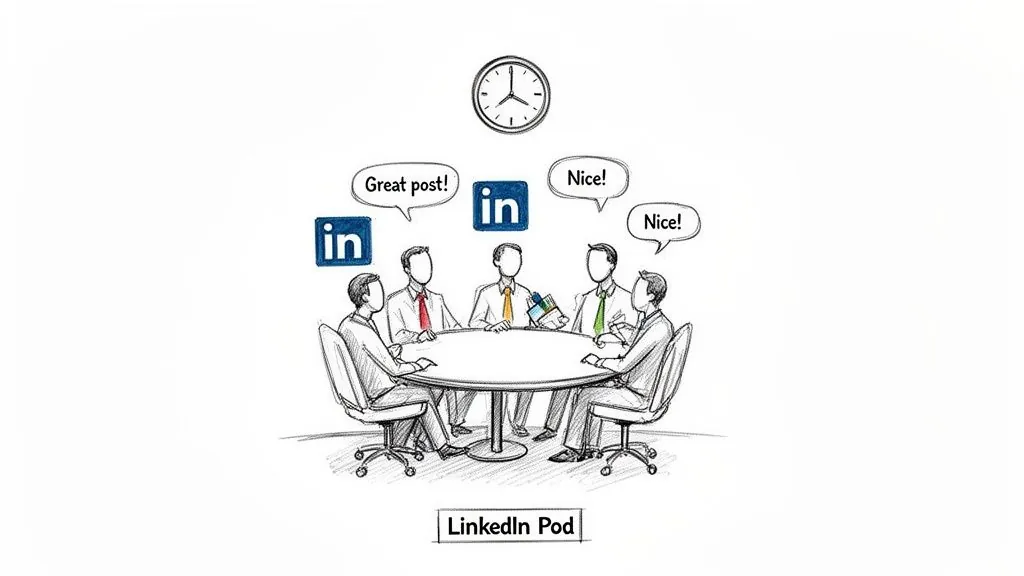
The idea behind pods came from a very real pressure to stand out. In a world where your professional brand is currency, getting traction on your content feels essential. Pods presented themselves as a clever workaround, a way to guarantee that initial flood of likes and comments instead of posting into the void and hoping for the best.
The Appeal of Instant Gratification
For busy professionals, from B2B founders to sales reps, the pull of a pod is completely understandable. The pressure to consistently publish high performing content is immense. This shortcut seems to solve a few key headaches:
- Saving Time: Why wait for organic engagement when you can get it on demand? Pods offer instant interactions.
- Guaranteed Engagement: It takes the guesswork out of posting. You know you'll get a baseline of activity.
- Beating the Algorithm: The theory is that a surge of early engagement will trick LinkedIn into showing your post to more people.
A LinkedIn pod is like an echo chamber. While it makes a lot of noise inside the group, the sound rarely translates into meaningful conversations with your actual target audience outside of it.
A Flawed Strategy from the Start
Here’s the problem: this entire tactic is built on a house of cards. At its core, LinkedIn is about genuine connection and building real relationships. You can see this in how successful brands use LinkedIn for small businesses: it's all about authentic communication, not coordinated inauthenticity.
The initial promise of a pod quickly sours into a major liability. That tempting quick win ultimately becomes a dead end for any serious professional. You end up prioritizing the quantity of engagement over its quality, which leads to a feed full of generic, "Great post!" comments from the same handful of people. Not only does this look fake to potential clients, but it also puts your account at risk.
This once popular trick is now a serious threat to your personal brand and business goals. The right approach is to build a sustainable presence and learn how to turn every piece of content into a growth opportunity authentically.
The Real Dangers of Inauthentic Engagement
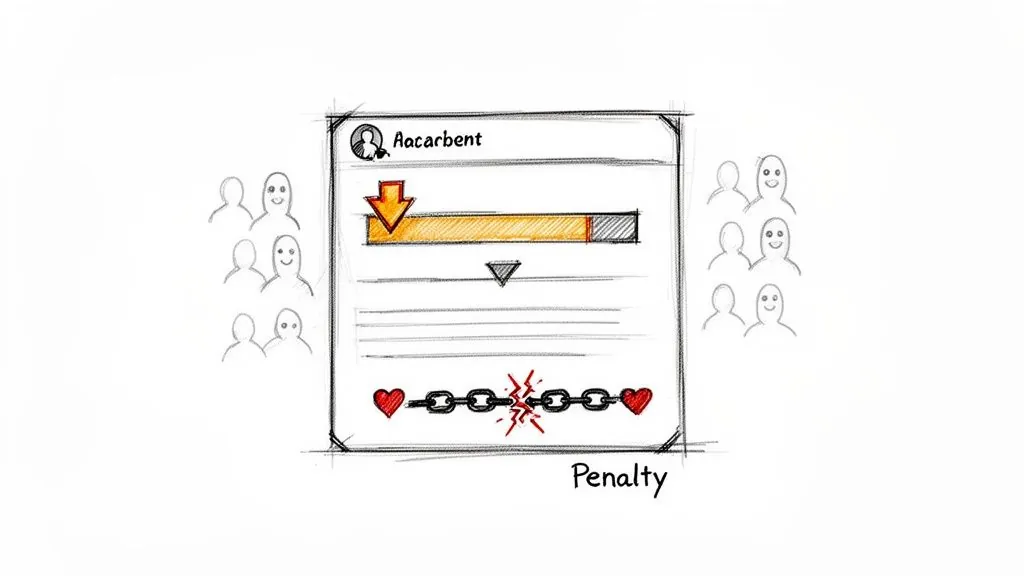
While the promise of instant visibility makes auto like groups tempting, the reality is that they often achieve the exact opposite. LinkedIn’s algorithm is incredibly sophisticated, and it has become remarkably good at spotting unnatural behavior.
When the same small circle of accounts instantly likes and comments on everything you post, it doesn't look popular: it looks coordinated. This pattern sends a huge red flag to the algorithm, signaling that the engagement is forced and inauthentic.
Think of your LinkedIn presence as having a "trust score" with the platform. Every genuine comment and meaningful interaction builds that score, telling LinkedIn your content is valuable and worth showing to more people. Auto like groups actively poison that score. The algorithm then starts to penalize you, burying your posts so they never reach the people who actually matter: your real prospects, clients, and peers.
The Escalating Risk of Account Penalties
The consequences for using these groups are getting steeper. LinkedIn is no longer just quietly reducing a post's reach; the platform is cracking down hard on what it views as manipulative tactics, leading to direct and painful account penalties.
These penalties aren't just a slap on the wrist. A temporary restriction can completely derail your sales pipeline, making you invisible during a critical product launch or marketing campaign.
A temporary account restriction on LinkedIn is like having the doors to your physical storefront locked during business hours. Potential customers walk by, see the lights are off, and simply go to your competitor next door.
Worse yet, repeat offenders risk a permanent account ban. Losing your account means your entire professional network, your content library, and all the credibility you've built are gone in an instant. For anyone who depends on LinkedIn for business, that's a catastrophic, and entirely avoidable, outcome. The illusion of popularity just isn't worth the risk.
The Sobering Statistics of Pod Participation
The data paints a very clear picture of this growing risk. Industry analysis shows a worrying trend for users relying on pods and other high volume tricks. Some studies predict these users could face a 23% account ban rate by 2026, costing their teams weeks of lost productivity and a damaged pipeline.
In stark contrast, profiles that focus on active, authentic posting see 3x higher connection acceptance rates and a massive lift in profile views. You can explore more about the future of LinkedIn automation on Bearconnect.io.
This data tells a simple story. While an auto like group might give you a fleeting sense of activity, it's a losing strategy in the long run. That short term vanity boost is completely overshadowed by the risk of platform penalties and the slow erosion of your professional reputation. Real, sustainable growth always comes from quality interactions, not fabricated ones.
How Generic Engagement Erodes Your Personal Brand
Getting your account flagged by LinkedIn is a real risk, but there’s a quieter, more insidious danger that comes with using engagement pods: the slow decay of your personal brand. Your credibility is the most valuable currency you have in the professional world, and trading it for hollow metrics is a losing game.
Think about it. Your activity on LinkedIn is a living, breathing extension of your resume. When a sharp prospect, potential business partner, or industry peer looks you up, they aren't just glancing at your posts. They’re sizing up the conversations happening around them.
What do they see? If it's just a wall of "Great post!" or "Thanks for sharing!" from the same few people over and over, the engagement immediately feels manufactured. It’s the digital version of a limp, disinterested handshake: a gesture that screams a lack of genuine interest and, worse, a lack of authenticity.
The Perception of Fake Popularity
This kind of forced interaction creates an illusion of popularity that’s surprisingly easy to see through. Anyone who's spent time on the platform can tell the difference between a real discussion and an orchestrated performance. When they see the same faces leaving the same shallow comments on all of your posts, the conclusion is obvious: you're trying to fake credibility instead of earning it.
That perception instantly shatters trust. If someone is willing to fake their online engagement, what else might they be disingenuous about? It plants a seed of doubt that can kill opportunities before you even know they existed.
Spotting Inauthentic Engagement
It’s crucial to understand what separates real interactions from fake ones. One builds your reputation, and the other quietly tears it down.
The table below breaks down the key differences between genuine, thoughtful engagement and the artificial activity you'd see from a LinkedIn pod.
Authentic Engagement vs. LinkedIn Pod Activity
| Attribute | Authentic Engagement | LinkedIn Pod Engagement |
|---|---|---|
| Comment Quality | Adds value, asks a question, or shares a relevant perspective. | Generic phrases like "Nice one!" or a string of emojis. |
| Timing | Comments appear organically over hours or days from various time zones. | A sudden burst of comments and likes within minutes of posting. |
| Participants | A diverse mix of new contacts and established connections. | The same small, recurring group of people on every single post. |
| Impact on Brand | Builds authority, credibility, and genuine professional relationships. | Creates suspicion, looks desperate, and devalues your expertise. |
Ultimately, a LinkedIn pod makes you trade long term respect for a fleeting, short term vanity metric.
Your personal brand is built on a foundation of trust. Every authentic interaction, every thoughtful comment and genuine connection, strengthens that foundation and proves your expertise. Pod activity, on the other hand, chips away at that foundation with every empty "Nice post!", leaving your professional reputation on shaky ground.
Why Chasing Vanity Metrics Is a Losing Strategy
The whole idea behind an auto like group is built on a shaky foundation: the belief that more engagement is always better. This sends people down a rabbit hole, chasing vanity metrics like likes, comments, and views that might look good at a glance but offer next to nothing in real business value. The focus shifts from building relationships to just puffing up the numbers.
This completely misses the point of how LinkedIn actually works. A post with 100 generic comments from a pod isn’t more valuable than a post with two thoughtful comments from ideal customers. The first is just noise; the second is the start of a conversation that could lead to a sale, a partnership, or genuine brand trust.
When you put quantity over quality, you're playing the wrong game. It's a strategy that wastes your time and puts your reputation on the line for stats that don't move the needle on your business goals.
The Massive Gap in Conversion
The classic marketing debate over lead quality vs. quantity is a perfect lens for this problem. When it comes to LinkedIn, a high number of likes just doesn't mean you're getting high value results. The numbers tell a pretty brutal story.
There’s a massive difference between the low quality interactions from pods and the genuine engagement that the platform itself rewards. Recent data shows that high volume, pod style tactics produce a dismal 1.7% lead conversion rate. In contrast, authentic engagement strategies, the kind LinkedIn's algorithm is designed to promote, see a much healthier 14.6% conversion rate. As you can see in ConnectSafely.ai's detailed comparison, the return on your time and effort is worlds apart.
Think about it this way: for every 1,000 people you reach, a pod strategy might get you 17 low intent leads. An authentic approach, on the other hand, could bring in 146 qualified prospects. That’s not just a small difference, it’s the gap between a failing strategy and a successful one.
Redefining Your LinkedIn Goals
This data makes you ask a really important question: what are you really trying to do on LinkedIn? Are you there to collect likes, or are you there to grow your business? If it's about business growth, then every single thing you do should be aimed at getting real world results.
Instead of getting bogged down by vanity metrics, start focusing on what actually counts:
- Meaningful Conversations: Are you starting real discussions with people in your target market?
- Qualified Leads: Is your activity catching the eye of potential buyers?
- New Partnerships: Are you connecting with peers and potential collaborators who can help you grow?
An auto like group, by its very design, can't deliver on these goals. It’s an inward facing echo chamber. Its only purpose is to create the illusion of activity, not to drum up real business. True growth happens when you stop performing for a small, captive audience and start engaging with the much larger professional world where your actual customers live.
A Smarter Path to Authentic LinkedIn Engagement
If you're tempted by the promise of instant popularity from a LinkedIn pod, I get it. But as someone who's seen this play out time and time again, I can tell you it's a dead end street. The real key to building influence and actually growing your business is to stop chasing fake engagement and start having intelligent, authentic conversations.
It’s time to shift from these risky, inward facing groups to a smarter, outward facing strategy that puts you in front of the people who matter: your actual customers and prospects.
Think about it. Real success on any social platform has always boiled down to being in the right place, at the right time, with the right message. This means targeting relevant conversations, timing your input for maximum visibility, and always, always sounding like yourself. Most importantly, it requires a human touch to make sure every interaction is a quality one.
Just look at the hard data. We've seen firsthand how authentic engagement stacks up against the empty calories of pod activity, and the results are night and day.
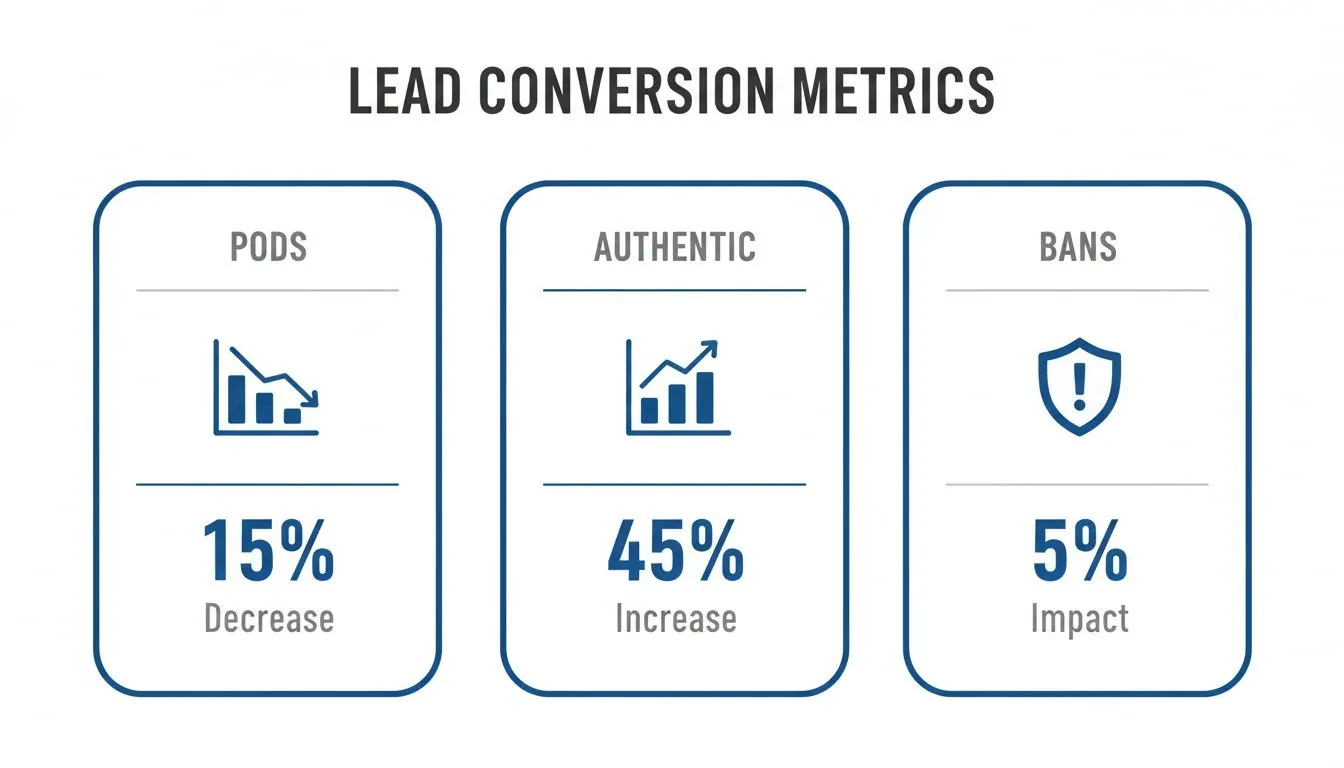
The numbers don't lie. While pods give you a fleeting vanity boost, they actively hurt lead generation and put your account on the fast track to getting banned. Authentic engagement, on the other hand, drives real, measurable growth.
A Modern Take on Engagement
So, how do you apply these principles at scale without living on LinkedIn 24/7 or breaking the rules? This is where intelligent automation comes in. Instead of a pod, imagine having a personal scout that sifts through the entire platform to find the perfect discussions for you to jump into.
This is exactly why tools like PowerIn are changing the game. They're built to help you establish genuine authority by getting you involved in the conversations that truly matter to your business. By using smart AI to draft contextual, human sounding comments on posts from your ideal prospects, you're not faking engagement: you're starting real conversations that lead to tangible opportunities.
Think of PowerIn as your personal networking assistant. It’s like having someone listening to every conversation at a massive conference, who then taps you on the shoulder to say, "Hey, they're talking about that thing you're an expert in over there. You should go say hello." It doesn't have the conversation for you; it just points you to the best ones to start.
You're in the Driver's Seat
The biggest flaw with a LinkedIn pod is that you give up all control. Your strategy is dictated by the group's "I'll scratch your back if you scratch mine" rules. A smart tool does the opposite: it puts you firmly in the driver's seat.
You get to be the strategist. With features like keyword monitoring and creator targeting, you can zero in on the exact conversations and people you want to engage with. This gives you a level of precision that pods simply can't match, allowing you to focus your energy on high value interactions that directly support your business goals. We've written a whole guide on how strategic commenting on LinkedIn boosts visibility if you want to dive deeper.
Finally, a manual approval workflow adds that crucial layer of safety and quality control. It ensures that every single comment that goes out under your name is on brand, adds genuine value, and sounds like you. It's this blend of targeted automation and human oversight that lets you scale your presence safely.
Sure, risky pod tools might claim to save sales teams up to 10 hours weekly, but that "saved time" comes with a constant low grade anxiety about getting banned. A smarter approach generates a steady stream of leads without the headaches, coordination, and risks of a LinkedIn pod.
Common Questions About LinkedIn Pods Answered
If you're serious about growing your professional brand, you've probably heard whispers about engagement pods. It's a confusing topic, so let's cut through the noise and get you some straight answers. I've seen countless professionals get tripped up here, so it's critical to understand what you're dealing with.
The first thing to get right is the difference between a real community and a LinkedIn pod. If a group's main rule is "you must like and comment on everyone's post to participate," that's a pod. Its entire purpose is to trick the algorithm. A genuine community, on the other hand, is built on shared interests and valuable conversation: engagement happens because people actually want to talk, not because they're forced to.
LinkedIn's algorithm is smart enough to know the difference. It rewards valuable conversation, not coordinated, inauthentic behavior. The intent is what matters: pods are there to fake metrics, while real communities are there to create value.
Can LinkedIn Really Detect Pod Activity?
Yes, absolutely. And it’s getting better at it every day. The platform is designed to sniff out unnatural engagement patterns.
Think about it: when the exact same group of people instantly likes and comments on each other's posts (often within minutes, regardless of time zones or topic) it leaves a glaringly obvious digital footprint.
It’s like being at a networking event where a small group of people stands in a tight circle, only talking to each other and high fiving every sentence. It looks weird, forced, and closed off. That’s exactly how a LinkedIn pod looks to the algorithm.
This kind of predictable, reciprocal activity is a massive red flag. It tells LinkedIn the engagement is low quality, which can crater your post's reach. In worse cases, it can lead to account restrictions for everyone involved. It’s a cat and mouse game you will eventually lose.
How Is a Tool Like PowerIn Different From a Pod?
The difference is night and day, and it all comes down to their core purpose. A LinkedIn pod is an inward facing tactic. It’s a closed loop designed to make a small group of people look popular to each other by trading generic, forced comments.
PowerIn is the exact opposite. It’s an outward facing tool built to spark authentic engagement with your actual target audience across the entire platform.
Instead of swapping "Great post!" with the same 50 people, PowerIn uses AI to find relevant conversations started by your ideal prospects. It helps you jump into those discussions with genuine, thoughtful comments. The goal isn't to inflate vanity metrics; it's to build real relationships and showcase your expertise to become a recognized LinkedIn Top Voice.
What Should I Do If I Am in a LinkedIn Pod Now?
If you've found yourself in a pod, the best thing you can do is exit gracefully. Don't just vanish overnight, that sudden drop in activity can be a red flag in itself. Here's a safer way to pull back.
- Slowly Fade Out: Over the next week or two, just get "busier." Reduce how often you're liking and commenting on the required posts.
- Leave Quietly: Once your activity has tapered off, simply leave the group chat or platform where the pod is organized. No need for a big announcement.
- Pivot to Real Engagement: Immediately shift your focus to authentic interactions. Start by manually leaving insightful comments on posts from industry leaders and potential clients you want to connect with.
- Use a Compliant Tool to Scale: Once you get the hang of it, you can use a tool designed for compliant, high quality engagement to scale those efforts. This safely transitions your strategy from risky business to rewarding growth.
Ready to grow your LinkedIn presence without the risk? PowerIn uses AI to help you find and join relevant conversations with your target audience, turning authentic engagement into real business opportunities. Attract prospects and generate leads around the clock by starting your free trial at PowerIn.