It’s easy to get tunnel vision and only focus on the companies that look and act just like you. But a truly effective business strategy means understanding your entire competitive landscape, which includes threats from some unexpected places.
The distinction is straightforward: direct competitors sell a product that’s almost identical to yours, targeting the very same customers. Indirect competitors, however, solve the same core problem for those customers, just with a totally different type of solution.
Understanding Direct vs Indirect Competitors
If you mistake one for the other (or worse, ignore indirect competitors completely) you're leaving your business exposed. These two types of rivals compete for your customer's budget and attention in fundamentally different ways, and you need a plan for both.
What Are Direct Competitors?
Think of a direct competitor as a near perfect mirror of your own business. They’re in your market, chasing your ideal customer profile, and solving the exact same pain point with a very similar product or service.
For a company like PowerIn, which provides AI powered comment automation for LinkedIn and X, a direct competitor is any other tool that automates social media engagement in a similar fashion. The battle here is for market share within a clearly defined category.
What Are Indirect Competitors?
Indirect competitors are trickier. They don't look like you, but they're still after your customer's wallet. They solve the same underlying need but come at it from a completely different angle.
Using our PowerIn example, the core customer need is B2B lead generation on social platforms. An indirect competitor isn't another AI tool; it could be a social media agency that handles engagement manually, a general CRM with some social features, or even online courses that teach people how to do their own outreach. Their offerings are different, but they are all vying for the same piece of the lead generation budget.
Don't underestimate them. Some research shows these indirect players can be a major force, driving as much as 32% of social driven traffic for B2B brands. You can find more insights by reviewing a deeper social media competitive analysis.
This side by side comparison neatly lays out the core differences.
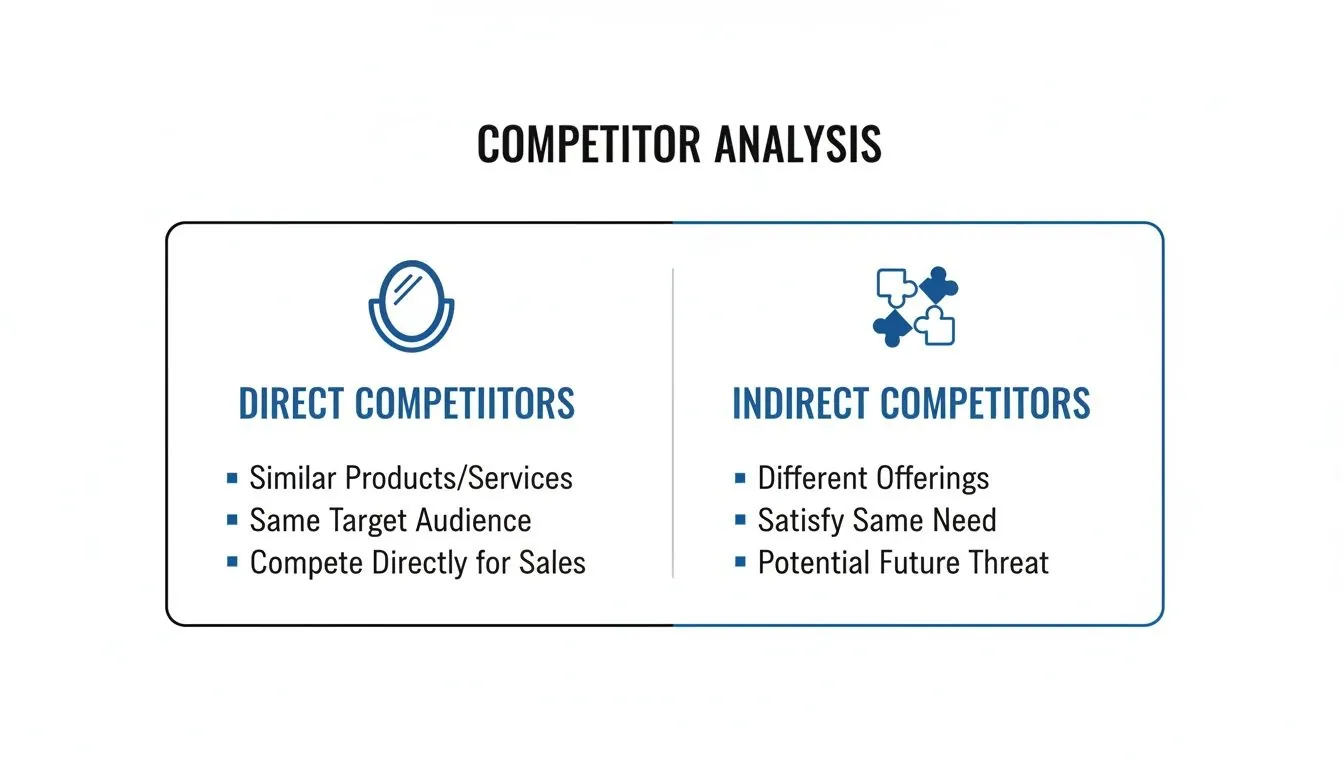
Ultimately, direct competitors offer a substitute for your solution, while indirect competitors present an entirely different path to get to the same destination.
Direct vs Indirect Competitors At a Glance
For a quick reference, here’s a breakdown of the key differences between these two types of competitors.
| Characteristic | Direct competitors | Indirect competitors |
|---|---|---|
| Core offering | Offers a similar product or service. | Solves the same problem with a different solution. |
| Target audience | Targets the exact same customer segment. | Targets the same customer from a different angle. |
| Primary goal | Win market share within the same category. | Win the customer's budget before they choose your category. |
| Example | Netflix vs. MAX | Netflix vs. a movie theater |
This table helps clarify who you're up against. Direct competition is a head to head fight, while indirect competition is a battle over the customer's fundamental approach to solving their problem.
Analyzing Your Direct Competitors
Think of your direct competitors as the companies in the next lane, racing for the same finish line. They’re selling a near identical solution to the exact same audience you are. Understanding them isn't just a box ticking exercise; it’s about mapping their entire game plan so you can find a way to pull ahead.
You have to go much deeper than just a quick look at their website. It's about a full teardown of their products, pricing models, and how they position themselves in the market. If you’re building a tool like PowerIn, that means getting into the weeds of how other automation platforms use Boolean keyword logic, what’s included in their different pricing tiers, and the exact words they use to sell their value.
Benchmarking Performance and Messaging
A great starting point is to benchmark yourself against them, but not just on features. Sure, you need to know if you’re at parity, but the real gold is in their weaknesses. Is their user interface a bit clunky and confusing? Is their customer support notoriously slow? Every frustration their customers have is a massive opportunity for you.
This same critical eye should be applied to their marketing. Read their ads, website copy, and social media posts. The claims they make, the benefits they highlight, all of it gives you clues on how to position yourself differently and more effectively.
To really get under the hood, a detailed competitor comparison can uncover strategic details you’d otherwise miss.
The real goal of analyzing direct competitors is to find the gap between what they promise and what their customers actually experience. That gap is where your business thrives.
Recent social media data from 2024 really drives this home, especially when looking at direct vs indirect competitors. In the LinkedIn/X automation space, direct competitors made up 55% of the top search rankings and dominated conversations with a 72% higher posting frequency. For B2B founders, this translated to competing tools that mimicked PowerIn's tone tailored replies grabbing 40% more profile visits in Q3 2024. The full findings from Popsters offer a deeper look at social media competitor analysis.
Identifying Gaps to Exploit
Once you have a solid map of their playbook, you can start pinpointing the exact gaps to attack. This means methodically breaking down their entire customer journey.
- Product Gaps: Do they only operate in English? Is their creator targeting tool basic? For PowerIn, this might mean shouting about its ability to target up to 50 creators at once and support for multiple languages.
- Pricing Gaps: Are their entry level plans too restrictive or their free trial too short? A more generous trial or a flexible, usage based plan could easily peel off customers who feel stuck.
- Service Gaps: Search for common complaints. Is their onboarding process a nightmare? Is their account security a concern? Highlighting your stellar support and top notch security features can become a core part of why customers choose you.
By constantly dissecting what your direct competition is doing, you shift from simply reacting to their moves to proactively outsmarting them. This isn't a one time project; it's a continuous process that keeps your product, marketing, and sales strategies sharp and one step ahead.
Uncovering Your Indirect Competitors
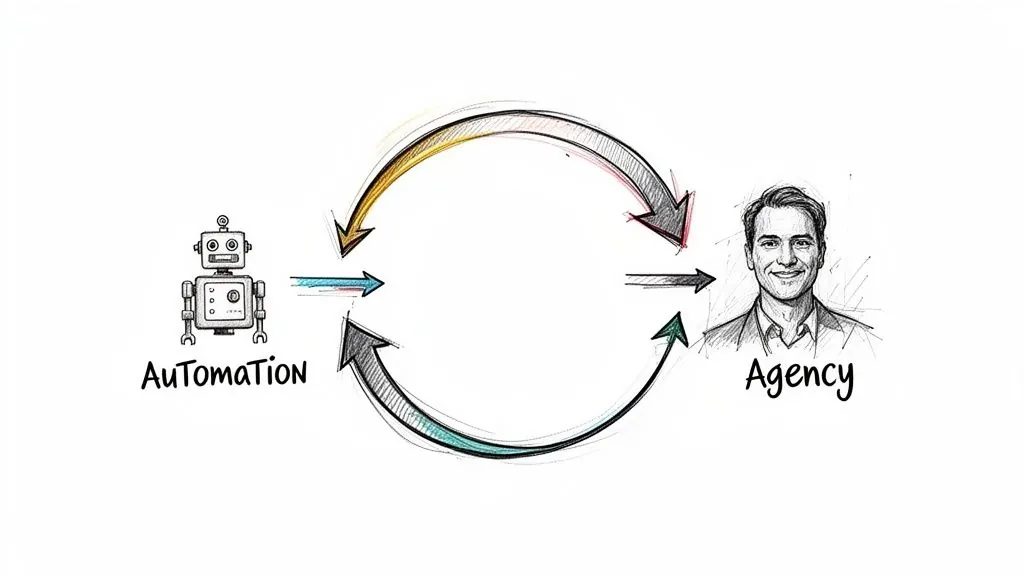
Direct competitors are the ones you see coming. Indirect competitors? They’re the ones that blindside you, stealing customers by solving the same core problem with a totally different approach. They’re gunning for the exact same slice of your customer's budget, often without ever showing up on your radar.
Think about an AI engagement tool like PowerIn. Our indirect competition isn't just another automation platform. It's the B2B social media agency doing things by hand. It's a massive CRM that has some basic social functions bolted on. It could even be a popular newsletter teaching people how to do manual outreach themselves. They all promise the same outcome, more leads, but through wildly different means.
Most businesses completely misjudge the threat here. When a potential customer hires an agency instead of buying your software, it's more than a lost sale. It’s a sign that they've chosen a different philosophy altogether, and you need to understand why.
Recognizing Non Obvious Strengths and Weaknesses
Getting a handle on the direct vs indirect competitors landscape means you have to stop comparing feature lists. Indirect competitors operate on a different value system, and their strengths can be surprisingly compelling. The good news is that their weaknesses are usually your biggest opportunities.
Let’s break down some common indirect competitors and their real world trade offs:
- Manual Agencies: People love the idea of a "human touch" and a custom strategy. That’s their big sell. But the reality is they are expensive, slow to react, and can't possibly scale their engagement to work 24/7.
- Broad CRM Platforms: The appeal here is the "all in one" dream, with everything under one roof. The problem? Their social engagement tools are almost always an afterthought: shallow, clunky, and missing the specialized power you actually need.
- DIY Educational Content: This route is attractive to anyone on a tight budget. For a small fee, they can learn the methods themselves. What they don't account for is the huge time sink and the frustratingly slow learning curve required to get any meaningful results.
The real secret is to shift the conversation away from features and focus on the method. You're not just selling a tool; you're selling a smarter, faster, and more scalable way to hit their goals.
Crafting a Winning Counter Position
Once you’ve mapped out these competing methods, you can build your argument. Your marketing and sales pitches need to hit the pain points of their current approach head on.
For instance, if you’re trying to win over someone considering a manual agency, don't just rattle off your AI features. Talk about what those features actually deliver.
- Efficiency: Frame it in terms of time saved. Automation gives their team back hours every single day, hours they can spend closing deals instead of just digging for them.
- Scalability: Highlight the sheer volume. You can engage with hundreds of relevant posts and creators at once, something a human team could never accomplish.
- Cost Effectiveness: Put the numbers side by side. Your subscription is a tiny fraction of an agency's retainer, delivering a much higher and more measurable ROI.
When you truly grasp what a customer wins, and what they give up, by choosing an indirect competitor, you can clearly position your solution as the obvious, superior path. You stop selling a product and start selling a winning strategy.
A Practical Framework for Competitor Identification
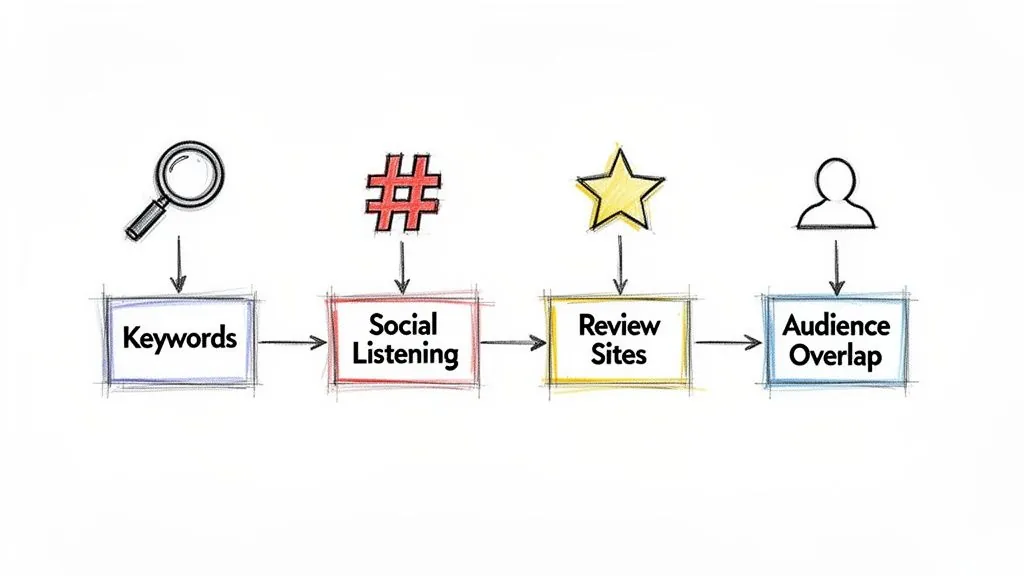
Finding everyone you’re up against, both the obvious and the not so obvious, isn’t about random Google searches. It requires a repeatable system that gives you a complete map of your competitive landscape, showing you exactly where the gaps and opportunities are hiding.
The key is to think like your customer. What words do they use to describe their problem? What questions are they asking? Starting there turns abstract market research into a concrete plan for uncovering your rivals.
Find Direct Competitors with Keyword Research
Your best bet for finding direct competitors is to look at your "money" keywords. These are the high intent search terms your ideal customers use when they're ready to buy.
Use a keyword research tool like Ahrefs or Semrush and see who consistently ranks for phrases like "best AI comment tool" or "LinkedIn lead generation automation." The businesses dominating these search results are your direct competitors, fighting you for the same digital real estate.
Look to Social Media and Review Sites
Your competitors aren't just on Google; they're wherever your customers hang out. Keep a close eye on industry specific hashtags on LinkedIn and X (formerly Twitter) to see which brands are driving the conversations.
Don't forget to check software review sites like G2 or Capterra. Go to your own product category and pay special attention to the "customers also viewed" or "compare" sections. This is a goldmine for spotting both direct and indirect players that your prospects are actively considering.
To systematize your search, here's a breakdown of methods and the tools that can help.
Competitor Identification Toolkit
| Method | Tool or platform | Best for identifying |
|---|---|---|
| Keyword analysis | Ahrefs, Semrush, Google Search | Direct competitors bidding on and ranking for high intent keywords. |
| Social listening | LinkedIn, X, PowerIn | Direct and indirect competitors leading industry conversations and engaging with your target audience. |
| Review site mining | G2, Capterra, TrustRadius | Direct and indirect competitors that customers are actively comparing you against. |
| Audience overlap | LinkedIn, SparkToro | Indirect competitors who have already captured the attention of your target audience. |
This process of gathering and analyzing information forms the foundation of strong competitive intelligence. It helps you build a full picture of the market, not just a snapshot.
One of the most powerful, and often overlooked, techniques is analyzing audience overlap. By looking at the followers of key industry creators on LinkedIn, you can discover which indirect competitors are winning the attention of your target audience, even if they offer a completely different type of solution.
The data backs this up. A recent study found that direct competitors in AI automation generated 52% of organic social traffic for B2B lead generation topics. In contrast, indirect competitors, like broad analytics platforms, only captured 25% of that traffic but saw a 22% jump in audience growth by jumping on emerging hashtag trends.
Mastering advanced search operators is a huge advantage here. Our guide on how to use Sales Navigator Boolean search can give you a serious edge in pinpointing these hidden competitors.
How to Outmaneuver Your Competition
Competitor analysis is useless if you don't act on it. Now that you've mapped out who you're up against, it's time to put that knowledge to work and build a strategy that actually wins you business. The tactics you’ll use, however, depend entirely on whether you're facing a direct or indirect competitor.
When you're up against direct rivals, the battle is often won by inches, not miles. You both offer similar solutions, so you have to carve out a "moat" around your business by getting laser focused on what makes you truly different: your unique value proposition. This is about moving past a simple feature list and emphasizing what you do better than anyone else.
For example, a tool like PowerIn might go head to head with another AI engagement platform. The winning move isn’t just to tack on another feature. Instead, you'd highlight a unique advantage, like superior multilingual support that helps users connect globally or advanced safety protocols that give customers genuine peace of mind.
Winning Against Indirect Competitors
Taking on indirect competitors requires a completely different playbook. Here, you’re not comparing feature for feature. You’re competing on the fundamental method of solving the customer's problem, and your job is to educate them on why your way is better.
This means your marketing messages need to draw a sharp contrast between the benefits of your solution and the hidden costs of theirs.
- Automation vs. Manual Agency: A founder using PowerIn can frame the argument around pure efficiency and scale. Why pay a hefty monthly retainer for an agency that only works 9 to 5 when AI can generate leads for you 24/7 at a fraction of the cost? The real conversation is about ROI and smarter resource allocation.
- Specialized Tool vs. All in One CRM: The argument here is depth over breadth. Let’s be honest, a generic CRM’s social features are usually an afterthought. Your positioning should highlight how a purpose built tool delivers specialized power and drives far better results for a specific, high value task like lead generation.
The key is to completely reframe the customer's decision. It's not about which product to buy; it's about which strategy will get them to their goal faster, cheaper, and more effectively. Your marketing and sales team must tell that story, loud and clear.
Think about how this plays out in the real world. A founder on a sales call can pivot the conversation the moment a prospect mentions they're considering a manual agency. You simply ask, "How will they measure the ROI on their time, and can they truly scale their outreach during a critical campaign?" That single question subtly exposes the cracks in the competitor's model.
Likewise, a marketer can use this intel to refine their ad campaigns. You could target users showing interest in big CRM platforms with copy like, "Tired of clunky social tools in your CRM? Get a dedicated solution built for leads." Learning how to build an effective LinkedIn sales strategy is the perfect next step to turn these kinds of insights into measurable results.
When you understand the distinct threat each type of competitor poses, you can tailor your response, sharpen your positioning, and build a narrative that makes your solution the only one that makes sense.
Turning Competitor Insights into Leads
All the competitor analysis in the world is just academic until it starts generating leads. The real goal isn't just to know what your rivals are doing: it's to turn that knowledge into a predictable pipeline of new customers. This means shifting from passively watching to actively engaging.
So, how do you do it? The key is to have two distinct playbooks: one for your direct competitors and another for your indirect ones.
With direct rivals, your strategy is all about interception. Every time a potential customer mentions a competitor by name, maybe they're complaining about a missing feature or a steep price, they're basically raising their hand and announcing they're in the market. That's your cue. By setting up keyword monitoring, you can spot these opportunities the moment they happen.
Of course, you can't be online 24/7. That's where a tool like PowerIn comes in. Instead of hunting manually, you get an alert and can automatically drop a genuinely helpful comment that positions your solution as the perfect answer to their problem.
Engage Your Indirect Competitor's Audience
The game changes when it comes to indirect competitors. Here, you're not trying to intercept a sale; you're looking to attract their entire audience. Think about it: creators, consultants, and agencies are already gathering your ideal customers and teaching them about the problem you solve. Your job is to show up in those conversations.
The most effective way to beat an indirect competitor is to become the most helpful voice in their community. You're not selling; you're educating their audience on a better way to achieve their goals.
By targeting the content these creators publish, you place your brand right in the middle of your customers' learning journey. A well timed, insightful comment on one of their posts does more than just get seen: it builds credibility and pulls interested people back to your profile. Suddenly, their content is working for you. We break down this exact process in our guide on how to turn every piece of content into a growth opportunity.
For example, you can set up a system to automatically monitor specific creators and keywords related to your field.
This kind of setup lets you engage with conversations happening around both direct vs indirect competitors around the clock. By being consistently visible and valuable, you can turn your competitors' hard earned audiences into your own steady stream of qualified leads.
Frequently Asked Questions
As you start digging into your competitive landscape, a few questions always seem to pop up. Let's tackle some of the most common ones so you can move forward with confidence.
How Often Should I Conduct a Competitive Analysis?
Think of competitive analysis less as a one off project and more as an ongoing part of your business's vital signs. It’s not something you can just set and forget.
For your direct competitors, a deep dive analysis every quarter is a solid rule of thumb. This keeps you in sync with their major moves. For indirect competitors, a thorough review every six months usually does the trick. Of course, this should be layered with continuous, real time monitoring to catch any sudden market shifts or new threats as they happen.
Can a Company Be Both a Direct and Indirect Competitor?
Absolutely, and it's more common than you might think, especially with large companies that have a sprawling portfolio of products.
A classic example is a major tech giant. They might have a specific app (say, a social media scheduling tool) that competes directly with your product. At the same time, their massive, all in one marketing suite (which includes that scheduler) acts as an indirect competitor to your standalone solution. The trick is to analyze each of their offerings on its own terms.
The biggest mistake in competitor analysis is focusing solely on direct rivals while ignoring the disruptive threat from indirect ones. The second biggest mistake is collecting data without ever translating it into actionable changes to your strategy.
What Is the Biggest Mistake in Competitor Analysis?
By far, the most costly mistake is developing tunnel vision. So many businesses get completely obsessed with their direct, look alike competitors and write off the indirect players as irrelevant. This leaves a massive blind spot, making them vulnerable to a different kind of solution that swoops in and solves the same core problem for their audience.
The other major pitfall is "analysis paralysis." It’s easy to get buried in spreadsheets and data points, but all that information is useless if it doesn't lead to action. A competitive analysis is only successful if it results in specific, tangible adjustments to your marketing, sales, or product strategy. Without that, it’s just an academic exercise.
Ready to turn competitor insights into a lead generation engine? With PowerIn, you can monitor your competitors' content and automatically engage their audience with high quality, contextual comments. Start attracting prospects and building your brand around the clock. Start your 5 day free trial today.